Difference Between Seamless And Welded Pipe In Construction
Jan 27, 2026
The material that supports itself under load will determine how well a structure we build, whether it's temporary (like a scaffold) or long-term, will last. When designing and building with steel, we are constantly talking about "steel pipes" because they are integral to every item that must sustain a load on a scaffold (for instance, any scaffold support).
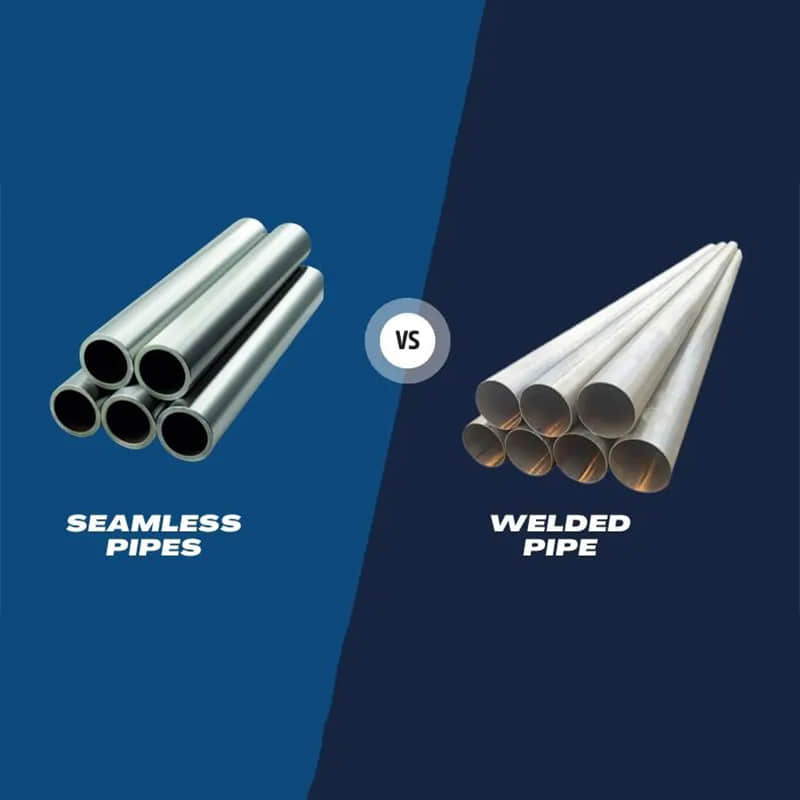
This article is meant to outline some of the fundamental differences between seamless and welded pipes. Some of the differences are as follows:
The ability to carry loads
Efficiency and durability in the structure
Although the appearance of seamless and welded pipe is almost the same, the way in which they are produced and their respective capacities to support a load is quite different.
1. The Tale of Two Manufacturing Processes
To determine how performance differs among these pipes, we need to consider the manufacturing process. The manufacturing method determines the grain structure and later the physical attributes of the steel.
Seamless Pipes (SMLS)
As the name implies, a seamless pipe has no longitudinal weld seam. It is manufactured through a process called extrusion.
The Process: A solid steel rod begins as a round shape that is heated at very high temperatures before being pushed through or drawn over a form, which is called a piercing rod, in order to make it hollow and create the hollow form.
The Result: The end result of this process is a consistent, uniform structure with equal strength all the way around the hollowed-out area (or tube). We do not introduce any possible points of stress concentration because there is no welding involved.
Welded Pipes (ERW/LSAW)
Welded pipes begin as a flat steel plate or strip (skelp).
The Process: The rolling of flat-rolled steel into a tube shape, followed by attaching the two edges of the tube using high-energy processes such as Electric Resistance Welding (ERW) (for steel construction).
The Result: A tube with precise dimensional tolerance but with the seam along the length of the tube. The modern processes have made the seam more robust; however, it still maintains a metallurgically unique zone.
2. Key Differences: A Technical Breakdown
When selecting materials for scaffolding, formwork, or infrastructure, comparing the technical specifications is vital. Here is how SMLS and welded pipes compare.
Pressure and Load-Bearing Capacity
This is often the deciding factor for structural applications.
Seamless Pipes: Because seamless pipes have no weld seams, they generally have a greater ability to withstand internally applied pressure and externally applied weight. The homogeneity of the steel will therefore allow for a greater working pressure calculation when compared to welded pipe of the same size and grade; approx. Twenty percent greater than the equivalent welded pipe.
Welded Pipes: There is a distinct region of the welded pipe structure that is the weld. The effect of modern heat treatments on the welded portions of pipestack is to lessen the weaknesses created by the weld. Nevertheless, some engineers apply "derating factors" to welded pipes in case of design conditions for high pressures or extreme load-bearing conditions.
Dimensional Tolerance and Wall Thickness
Seamless Pipes: Seamless pipes may have slight variations in wall thickness and roundness because they are produced by an extrusion process; therefore, they are not always perfectly round.
Welded Pipes: Welded pipes come from steel sheets that are processed with precision rolling, which results in the welded pipes having consistent wall thickness and excellent quality of surface finish. The uniformity of the welded pipe makes it easier to couple and fit together with modular building structures using clamps.
Cost and Availability
Seamless Pipes: Seamless pipe manufacturing involves lengthy and complicated steps, requiring significant amounts of energy to manufacture. As such, it can generally take much longer for the finished product to go through all stages of the manufacturing process.
Welded Pipes: Welded pipes can be produced quickly with an automated process. For many companies, the ability to produce large quantities of welded pipes in bulk enables the company to pass those savings along to customers as lower prices.
3. Application Analysis: Which Type to Use?
The choice between seamless and welded pipes often balances safety standards, environmental conditions, and project budgets.
When to Use Seamless Pipes
Seamless pipes are often the preferred choice for critical environments where failure is not an option. They are typically specified for:
Heavy Industrial Scaffolding: Heavy Industrial Scaffolding is used in locations including Marine Structures like offshore platforms and Land-based Structures like refineries and power plants where pipes exist in a high-pressure, harsh, and/or corrosive atmosphere and subject to extremely high levels of vibration (225368.13 Pascal/Hours).
High-Load Falsework: High-Load Falsework applications include those where the pipe acts as a vertical column supporting very large loads from concrete (massive concrete loads).
Harsh Environments: Harsh Environments refer to the extreme environmental conditions (weather/climatic) in which pipes are installed that will increase the chances of corrosion at the weld site; therefore, the absence of a weld seam provides less chance of preferential corrosion occurring.
When to Use Welded (ERW) Pipes
For the majority of general construction and infrastructure needs, High-Frequency ERW pipes act as the industry standard.
Standard Facade Scaffolding: The welded pipe material used to create access points, maintain, and lay bricks in standard facade scaffolding should be a strong, safe product that meets industry-recognized standards like EN 39 or BS 1139.
Fencing and Barriers: Non-load-bearing applications such as fencing or barriers would benefit from the lower cost of welded steel pipe and have a superior finish compared to most other types of pipe.
General Construction: In general construction applications (without any extreme pressure), welded pipe provides the best combination of cost-effective performance and economics compared to some other products.
Note: Always verify the Standard (e.g., ASTM A53, BS 1139, EN 10219). A high-grade welded pipe is often safer and more reliable than a low-grade seamless pipe. The specification is just as important as the manufacturing method.
4. Quick Comparison Table
Feature
Seamless Pipe (SMLS)
Welded Pipe (ERW)
Strength
Superior, uniform strength.
High, but structurally distinct at the seam.
Pressure Rating
High-pressure capability.
Low to Medium pressure capability.
Surface Finish
Rougher, varying tolerances.
Smooth, high consistency.
Corrosion Resistance
High (no seam for rust to attack).
Good (dependent on treatment).
Cost Implications
Higher investment.
Cost-effective.
Primary Use
Heavy Load-bearing, Industrial.
Scaffolding, Fencing, General Construction.
5. Conclusion
The selection of a suitable material plays an essential role in the permanent success of any project within the construction industry. If the correct choice between seamless or welded pipe is made initially, it will help build a strong foundation on which to build your project.
Seamless pipes are designed to provide the best possible strength in the most severe application environments. Conversely, modern welded pipes provide an equal, if not better, performance than traditional welded pipes for most scaffolding and infrastructure applications while providing a much lower purchase price. To be able to use either option, it is important to match the specifications of your selected pipe to both your specific load and the environmental conditions of your project.
When selecting either of these types of pipes, the best way to ensure that the pipes you are using for your construction project will perform at their highest level of safety and performance is to select pipes that meet international standards and come complete with verified Mill Test Certificate (MTC) documentation.
Need Technical Assistance?
Choosing the proper specifications for steel can be very complicated. From high-tensile seamless tube products built specifically for demanding service loads to more general applications of bulk welded pipe, there are many options available; to determine which would work best, talking with an expert can help narrow down the choices.
Our team is here to help with your project requirements and determine the appropriate steel pipe option to meet your load-bearing capacity.
FAQ
Can welded pipes be used safely for scaffolding?
Yes, absolutely. High-quality welded pipes (specifically High-Frequency ERW) are the industry standard for most façade and access scaffolding. As long as the pipes are manufactured to recognized standards like EN 39 or BS 1139, they provide sufficient strength and safety for general construction use. Seamless pipes are typically reserved for specialized, high-load, or industrial environments.
How can I visually tell the difference between seamless and welded pipes?
The most obvious sign is the weld seam.
Welded Pipe: You will usually see a faint line running along the length of the pipe's interior. In some high-grade finishes, this seam is smoothed out (scarfed), but the internal surface often feels smoother than the exterior.
Seamless Pipe: There is no longitudinal line. However, the surface might feel slightly rougher, and the cross-section may not be perfectly circular (slight ovality) compared to the precision roundness of a welded pipe.
Is a seamless pipe always stronger than a welded pipe?
Generally speaking, seamless pipes have a higher pressure rating (about 20% higher) because they lack a weld seam, which is a potential weak point. However, strength also depends heavily on the steel grade. A high-grade welded pipe can be stronger than a low-grade seamless pipe. Always compare the specific material specifications (e.g., S235 vs. S355 steel) rather than just the manufacturing method.



 en
en fr
fr es
es