The Definitive Guide to Scaffold Toe Board Requirements: An In-Depth Resource
Apr 16, 2026
Construction safety can be measured in inches due to the high level of risk involved at a construction site. While the primary focus of scaffold safety is typically placed on fall protection systems and structural stability, the safety of workers and the public is also largely dependent upon toe boards.
The construction industry has a “fatal four,” and falling objects are still one of them. A bolt, a wrench, or a brick slipped from the work platform can all be deadly. That’s where scaffold toe boards provide a needed level of safety.
In this guide, we will cover the requirements and specifications for scaffold toe boards, as well as how to follow the regulations outlined by OSHA and ACI.
1. About Scaffold Toe Board
A scaffold toe board is a vertical edge of a platform that is fastened down and prevents tools or scrap, or anything else, from falling from height off the work area. The guard rails provide protection for workers from falling off, while the toe boards provide protection to the general public or those below the work platform.
Falling object protection systems, as outlined in OSHA 1926.451(h), require toe boards to be installed in order to be compliant if employees are required to be in or pass under the scaffold.
2. Key Regulatory Requirements for Toe Boards
To maintain compliance and ensure maximum safety, toe boards cannot be "improvised." They must meet specific dimensional and structural criteria.
Height Requirements
The most critical dimension is the vertical height.
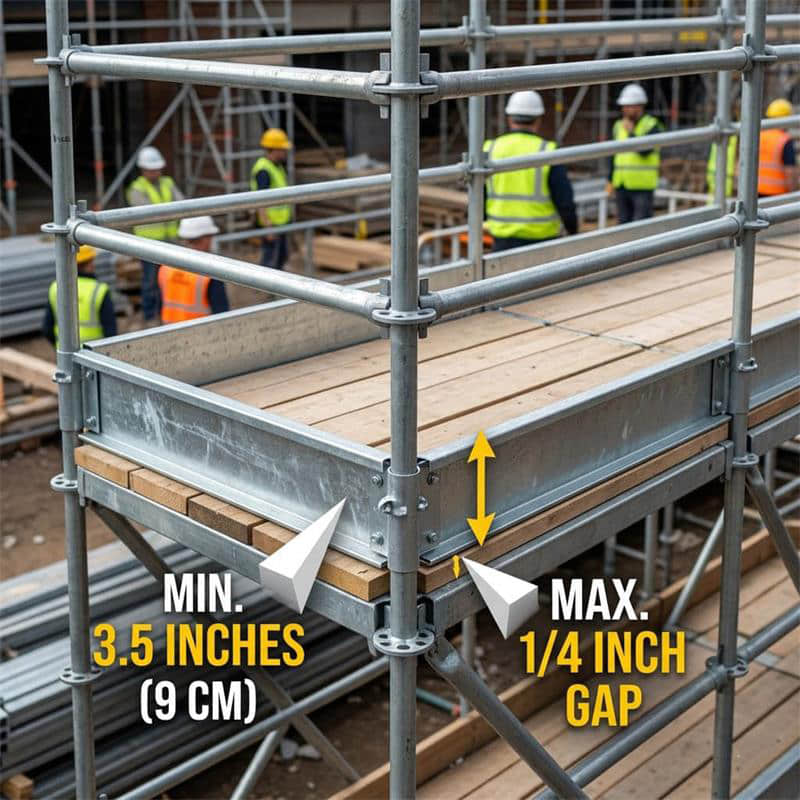
Minimum Height: According to the OSHA regulations, along with many other International Standards, the tops of all toe boards shall be situated at least 3.5 inches (9 cm) above the walking/work surface.
Standard Practice: Many employers who care about safety will use either 4" or 6" toe boards as an additional margin of safety when working with loose materials like rocks, stones, or small parts.
Clearance and Gaps
Toe boards may not work properly if there are large spaces that exist beneath the toe boards.
Maximum Gap: The gap between the base of the toe board and the surface of the platform (flooring) shall not be greater than one-quarter inch (0.6 cm). This will prevent small objects (nails, screwdrivers, etc.) from falling through the opening underneath the toe boards.
Structural Strength
Toe boards are not merely decorative; they must withstand physical impact.
Resistance to Force – Toe Boards shall typically provide at least a resistance of 50 lbs. (Approx. 222 N) of force in both the horizontal and vertical directions.
Stiffness – Toe boards shall be secured in place and constructed of either solid material or mesh with openings no greater than 1/2 inch. They will be built to maintain their shape and integrity under normal operating conditions.
3. Material Standards: Wood vs. Steel vs. Aluminum
Choosing the right material for your toe boards impacts both the longevity of your equipment and the ease of installation.
Material
Pros
Cons
Timber (Wood)
Cost-effective, easily cut to fit custom scaffold shapes.
Susceptible to rot, cracking, and warping; requires frequent inspection.
Steel
Extremely durable, high impact resistance, ideal for heavy-duty industrial sites.
Heavier to transport; prone to corrosion if not galvanized.
Aluminum
Lightweight, corrosion-resistant, easy to install with modular systems.
Higher initial cost; can be dented by heavy machinery impact.
For long-term ROI, many scaffolding rental companies prefer galvanized steel or aluminum toe boards due to their ability to withstand multiple cycles of assembly and disassembly without degrading.
4. Installation Best Practices for Maximum SEO & Safety
Proper installation is the bridge between a "compliant" site and a "safe" site. Follow these steps to ensure your toe boards are effective:
Perimeter Coverage in Full: Toe boards must be put at every end and side that is open on the platform. Any openings in the perimeter can allow debris to fall out.
Sealing and Overlap Between Boards: Multiple boards used should be either overlapped or flush with one another. The ends of the toe boards should not be left with any gaps between the ends of the board.
Fastener that is Secure: Fasten toe boards to the scaffold posts (uprights) with dedicated toe board clips or wire. Simply using gravity will not provide enough resistance for the toe boards to stay in place.
Integration with Netting: In high-traffic urban areas, use toe boards and debris netting ("fans") together. The toe boards will stop the larger loads (i.e., heavy material dropping to the ground), and the netting will catch any smaller material (i.e., dust and particles).
5. Common Compliance Pitfalls to Avoid
During safety inspections, several common errors often lead to fines or "stop-work" orders:
Use of Damaged Materials: A toe board constructed from a broken board would violate regulations regarding the structural integrity of materials used around foot traffic on scaffolds if the structure of a toe board is compromised under the 50lbs force test.
Not Using Toe Boards on the Ends of Scaffolds: Toe boards are often placed on the long sides of a scaffold, while the toes are placed on the ends of the scaffold. This leaves an important gap, placing workers in jeopardy of falling off the scaffold without the use of a toe board.
Mismatched Toe Board Height: A 2x4 timber can be used as a toe board since it is 3.5 inches in height; however, if the platform has not been constructed uniformly, this one may not meet code as a toe board due to the effective height below that required by code.
Failure to Inspect Scaffolds after Adverse Weather: Wind and rain can cause fasteners to come loose. Therefore, it is required that toe boards be inspected every day prior to the use of a scaffold.
6. The Economic Impact of Proper Toe Board Usage
Beyond the moral obligation to protect lives, adhering to scaffold toe board requirements makes financial sense for construction and engineering firms.
Avoidance of Fines: OSHA penalties for "Serious" violations can exceed $15,000 per instance.
Lower Insurance Premiums: A clean safety record with zero "falling object" claims helps in negotiating lower workers' compensation and liability insurance rates.
Project Efficiency: Preventing dropped tools means less time wasted retrieving items and less money spent on replacing damaged equipment.
Conclusion
The scaffold toe board may be the smallest part of your temporary structure, but its role in site safety is monumental. By ensuring your toe boards meet the 3.5-inch height requirement, maintain minimal gaps, and possess the structural strength to withstand impact, you are protecting your workforce, the public, and your company's reputation.
Compliance is not just about checking a box—it is about creating a professional, controlled environment where workers can focus on the task at hand without fearing for those below.
Need to Upgrade Your Site Safety?
Whether you are a building contractor looking for compliant scaffolding components or a distributor seeking high-quality safety equipment, we are here to help.
[Contact Our Safety Experts Today] to explore our range of OSHA-compliant steel and aluminum toe boards, or request a quote for your next major project. Let’s build a safer future together.
FAQ
Is a toe board always required on all scaffolding?
According to OSHA and international safety standards, toe boards are required on any scaffold platform that is more than 10 feet (in some jurisdictions, 6 feet or 2 meters) above a lower level, specifically when people are required to work or pass underneath the scaffold. If there is a risk of tools or materials falling onto someone, toe boards are mandatory regardless of height.
Can I use a standard 2x4 timber as a scaffold toe board?
Yes, but with a caveat. A standard "2x4" actually measures 1.5 x 3.5 inches. Since the minimum height requirement is 3.5 inches, a 2x4 meets the bare minimum. However, if the board is slightly worn or the platform is uneven, it may fall out of compliance. Many professionals prefer a 2x6 (which measures 5.5 inches) to ensure they are always above the safety threshold.
What should I do if materials are piled higher than the toe board?
If you are stacking bricks, tiles, or debris higher than the 3.5-inch toe board, the toe board alone is no longer sufficient. In these cases, you must install paneling or screening (such as fine mesh) from the toe board to the top of the guardrail until the materials are secured.



 en
en fr
fr es
es