For most construction or material supply purposes, the so-called 1-inch board, or 1x timber, is used for shelving, light forming, or as a decorative facing. However, there are structural limitations to using timber of this dimension for anything more than very light construction.
How much weight can a 1-inch board hold? Simple questions have simple answers that are simple until you delve a little deeper. How fast can a car go? It depends on the car, the road, and the driver. How much weight can a 1-inch board hold? It depends on the wood species, the span, and the type of load.
Before calculating weight capacity, we must address a fundamental industry standard. In North America and many international markets, a "1-inch board" is the nominal size.
After milling and planing, the actual thickness of a 1x12 board is typically 3/4 of an inch (19mm). This 25% reduction in thickness significantly impacts the board's moment of inertia and its resistance to bending. For the purposes of this guide, we will focus on standard 3/4-inch actual thickness boards, as these are what contractors and distributors handle daily.
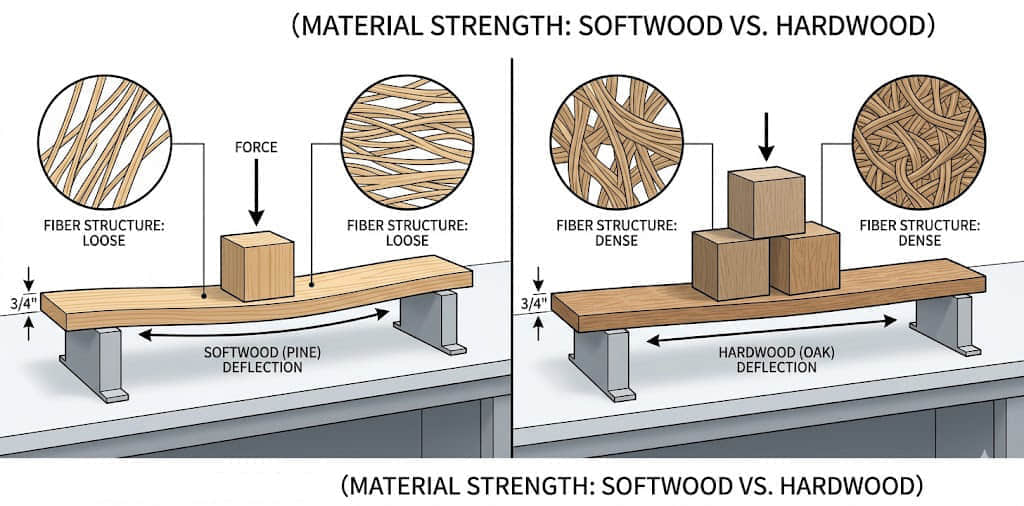
Not all wood is created equal. The cellular structure of the wood determines its Fiber Stress in Bending ($F_b$) and its Modulus of Elasticity ($E$).
Softwoods (Pine, Spruce, Cedar): Generally used in general construction. A 1-inch Douglas Fir board will significantly outperform a 1-inch Eastern White Pine board due to its higher density and grain tightness.
Hardwoods (Oak, Maple, Walnut): These offer much higher load capacities but are cost-prohibitive for large-scale industrial use. They are often the choice for high-end cabinetry or specialized heavy-duty shelving.
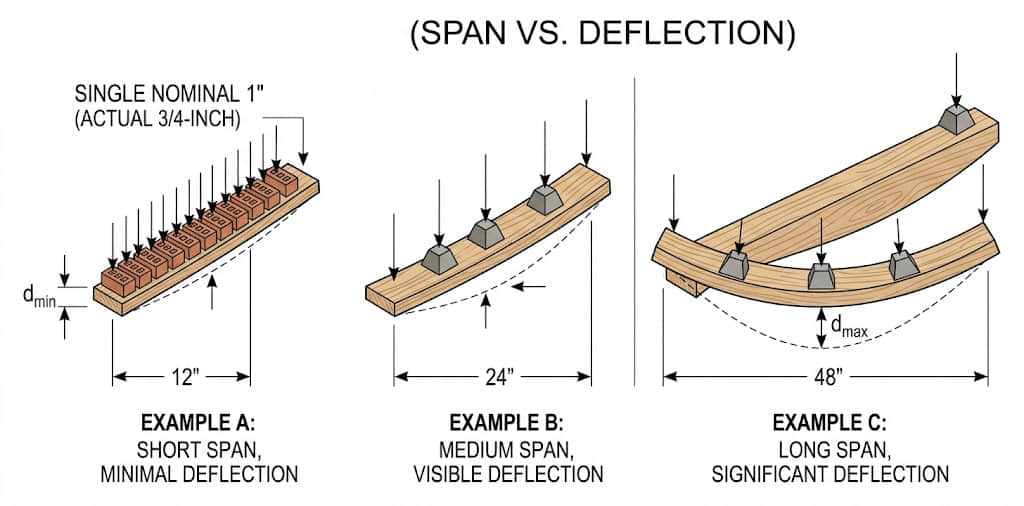
The distance between the two points supporting the board (the span) is the most critical variable.
The Golden Rule: If you double the span of a board, its weight capacity doesn't just drop by half—it drops exponentially.
For example, a 1-inch thick board that can safely hold 100 lbs over a 12-inch span might only hold 25 lbs safely if the span is increased to 24 inches.
To provide actionable data for construction and trade professionals, let’s look at the estimated Uniformly Distributed Load (UDL) for a standard 1x12 (3/4" actual) board of common construction-grade Pine or Fir.
|
Span Length (Inches) |
Estimated Safe Load (lbs) - Pine |
Estimated Safe Load (lbs) - Oak |
|
12" |
150 - 200 lbs |
300+ lbs |
|
18" |
70 - 90 lbs |
150 - 180 lbs |
|
24" |
30 - 50 lbs |
70 - 90 lbs |
|
30" |
15 - 25 lbs |
40 - 50 lbs |
Disclaimer: These figures are estimates for non-structural applications. Always consult a structural engineer for load-bearing architectural requirements.
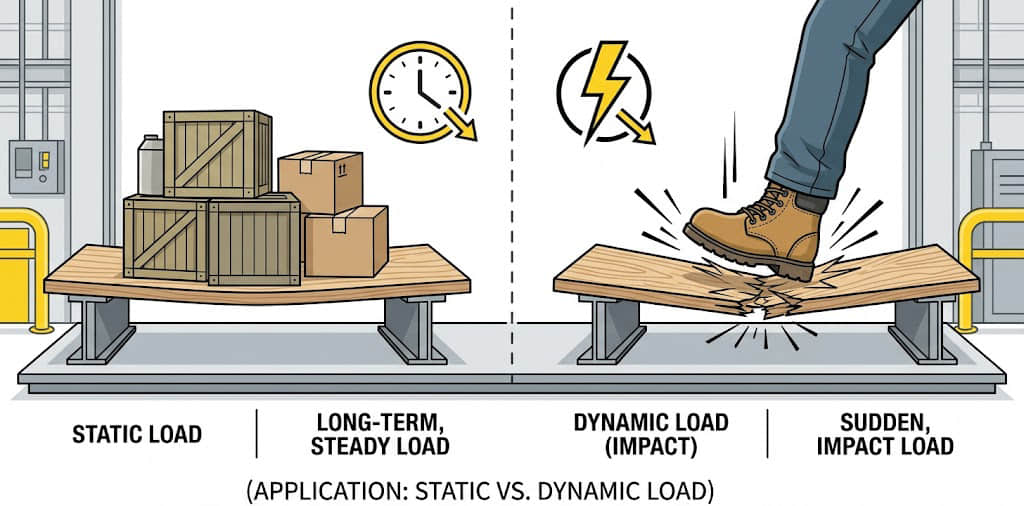
When a building material trader or an engineering firm calculates limits, they must distinguish between how the weight is applied:
A 1-inch board might hold 50 lbs of static weight indefinitely, but a 50 lb impact force could cause an immediate catastrophic failure. For safety in industrial environments, a safety factor of at least 3:1 is typically applied.
In most professional scenarios, a board will "fail" in the eyes of a client long before it actually snaps. This is called deflection (sagging).
For aesthetic and functional purposes (especially in shelving or scaffolding-adjacent applications), the industry standard for "acceptable sag" is often L/240. This means for every 240 inches of span, the board should not deflect more than 1 inch. For a 24-inch shelf, that’s a mere 0.1-inch limit.
Beyond this point, the board looks unstable, and items may slide toward the center, increasing the risk of collapse.
If you are stuck with 1-inch boards but need to support heavier loads, consider these professional workarounds:
For construction firms and public utility departments, sourcing the right grade is essential. Select Tight Knot (STK) or Clear grades will always hold more weight than "Utility" or "Common" grades, which contain knots. Knots act as stress concentrators and are the primary points where a 1-inch board will snap under pressure.
A 1-inch board is a remarkably capable component when used within its limits. While it can easily hold 100+ lbs over a short, 12-inch span, that capacity vanishes quickly as the span exceeds 24 inches. For procurement officers and site managers, the key is to balance the wood species selection with proper structural support to ensure longevity and safety.
Are you planning a project that requires high-performance lumber or specialized scaffolding solutions? Don't leave your load calculations to chance.
[Contact our technical team today] for a consultation on the best materials for your specific engineering needs, or browse our latest catalog of high-grade construction timber and template systems.
Yes. While thickness determines the board's inherent stiffness, the width (e.g., a 1x6 vs. a 1x12) distributes the load across a larger surface area. A 1x12 board will support more Uniformly Distributed Load (UDL) than a 1x6 of the same species, but it is equally susceptible to "cupping" or twisting if the load is not centered.
It depends on the direction of the force. Solid wood is generally stronger when the load is applied perpendicular to the grain over a span. However, Plywood (specifically 3/4" or 1" architectural grade) is more dimensionally stable and resists splitting and warping better than solid wood, making it superior for wide platforms or humid environments.
For a 1x12 Pine board with a 24-inch span, the theoretical breaking point (ultimate failure) may be around 200–250 lbs. However, for safety and to prevent permanent deformation, the safe working load is typically restricted to under 50 lbs. Never design a project based on the breaking point; always design for the deflection limit.
Email : aj-steven@dghualifeng.com.cn


Friendly Links :
Kitchen Cabinet© 2026 Guangzhou AJ Building Material Co.,Ltd All Rights Reserved


 en
en fr
fr es
es