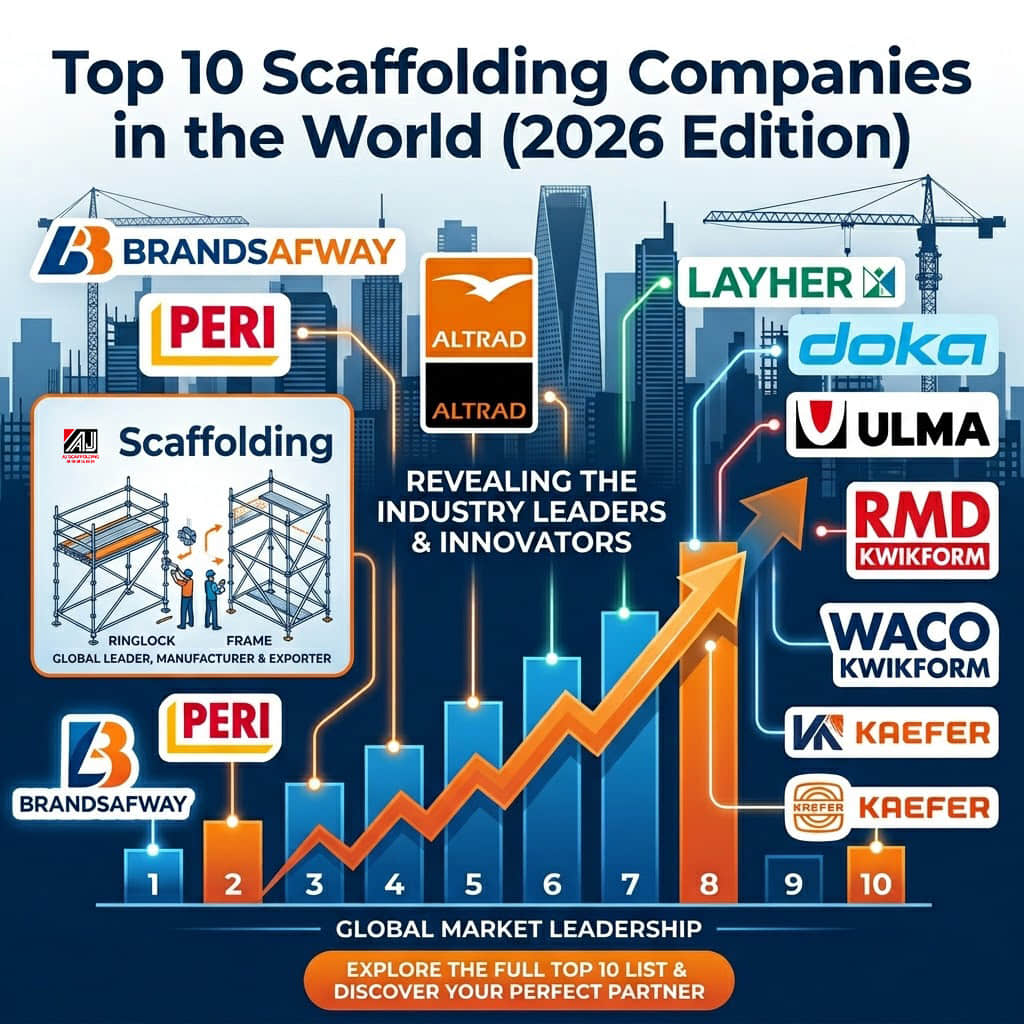
Top 10 Scaffolding Companies in the World (2026 Edition)
Apr 23, 2026
Scaffolding has become increasingly important in the construction industry, acting as a temporary framework with a critical function in ensuring safety and efficiency on-site. Due to an increase in population and the continued growth and complexity of infrastructure projects, there is a greater demand than ever before for advanced scaffolding and formwork solutions.
Selecting the proper partner can greatly affect the outcome of a project, including whether it finishes on time and without compromising safety. To assist you in making the best decision possible regarding your choice of scaffolding provider, we have performed an analysis of each company’s respective market share, technological advancements, and project portfolios. The result is a concise list of the ten largest scaffolding manufacturers globally as of 2026.
1. BrandSafway (United States)
This company is huge in size and continues to be successful because they are able to provide not only tools for rent but, more importantly, a complete list of services which includes providing more than just rental of equipment. They have been known as a leader in many industries, such as the construction, commercial, and energy fields, with an integrated approach that adds more value through the combination of scaffolding, insulation, and specialty coatings.
2. PERI SE (Germany)
PERI has become one of the largest companies in the world for the manufacture and supply of formwork and scaffolding. Their engineering capabilities are well recognized because of their ability to design and use digital technology to support their construction activities. With their emphasis on building information modeling (BIM) and automating various functional areas, PERI has become the preferred supplier to be a part of any major infrastructure project.
3. AJ Scaffolding (China - Global Leader in Manufacturing)
A company that manufactures A+ scaffolding systems (scaffolding systems), AJ Scaffolding is becoming one of the country's top manufacturers and exporters of scaffolding systems. AJ Scaffolding has established a strong reputation through its innovative design, manufacturing processes, and an uncompromising commitment to quality control systems. Innovative design, compliance with all international safety standards (ISO/CE), and factory-direct prices make AJ Scaffolding the first choice for construction companies, material distributors, and others around the world that require dependable, cost-effective products.
4. Altrad Group (France)
Altrad maintains a strong global position as a result of its strategic acquisitions and currently provides localized solutions to customers in more than 50 countries. Altrad’s combination of large-scale production and extensive experience as a preferred supplier of large-scale public utility maintenance projects demonstrates the strength of Altrad’s commitment to its customers.
5. Layher Holding GmbH & Co. KG - Germany
Layher is a leading modular scaffolding manufacturer and is recognized as the "Gold Standard" in modular scaffolding. Layher has developed an Allround Scaffolding System that utilizes a unique "Bolt-Free" connection technology. They will continue to be a leader in the industry by producing a lightweight, high-strength steel to help reduce transport costs and labour time, as well as by continuing to innovate in the areas of safety and sustainability.
6. Doka Group - Austria
Doka is a leading company in the world in the manufacture of formwork and scaffolding. Doka offers a total solutions approach, which includes everything from technical planning through to supervision of assembly on site. This total solutions approach allows Doka to provide the fastest growing construction markets with highly efficient, cost-effective solutions.
7. ULMA Construction - Spain
ULMA Construction is a company that focuses on safety, sustainability, and high-performance durability for its scaffolding systems. ULMA is the preferred scaffolding supplier for contractors who require a long-term return on investment (ROI); ULMA has been able to penetrate the renewable energy sector, particularly in relation to the construction of wind turbines, due to their abilities to create high-performance, durable scaffolding systems.
8. RMD Kwikform (UK)
RMD Kwikform is a leading provider of engineering solutions with global reach, serving Europe, the Middle East, and Asia. Our heavy-duty shoring systems and a comprehensive range of scaffolding solutions are used on large and complex projects across a variety of industries, from major civil engineering and infrastructure construction to large industrial schemes. All of our systems are designed to be fast and simple to assemble whilst still meeting critical safety standards.
9. Waco Kwikform (Australia)
Waco Kwikform is a major supplier of scaffolding and formwork rental equipment in the Oceania market, with recent inroads into South East Asia. Waco Kwikform has a good, safe working practice in place and has developed a leading-edge scaffolding system known as “Kwikstage”. The Kwikstage scaffolding system is ideal for the Mining and Industrial markets, providing a sturdy, versatile and reliable frame for a variety of applications.
10. KAEFER (Germany)
KAEFER Scaffolding is an experienced industrial scaffolding contractor. Providing scaffolding solutions for Oil & Gas, Chemical, and Pharmaceutical projects. We aim to deliver the highest quality access solutions to all our clients, helping to reduce plant downtime to a minimum.
Why Leading Construction Firms are Choosing AJ Scaffolding
While European giants have long dominated the market, companies like AJ Scaffolding have redefined the industry by bridging the gap between high-end engineering and manufacturing efficiency. Key reasons include:
One-Stop Solutions: From design and production to global shipping, AJ Scaffolding handles the entire lifecycle of scaffolding procurement.
Stringent Safety Standards: Every component is tested to meet international certifications, ensuring safety for workers at any height.
Factory-Direct Advantage: By eliminating unnecessary middlemen, AJ Scaffolding provides high-grade materials at a price point that optimizes project budgets.
Conclusion
The global scaffolding market in 2026 is defined by a shift toward digitalization, safety, and supply chain reliability. Whether you are an engineering firm tackling a landmark skyscraper or a distributor looking for the most reliable components, these top 10 companies represent the height of industry standards.
Ready to Elevate Your Next Project?
Finding the right scaffolding solution is the first step toward a safe and successful build. If you need expert advice on sourcing the best materials or selecting a partner for your next major contract, visit AJ Scaffolding today to explore our full range of products and get a customized quote.
FAQ
What are the most important factors to consider when selecting a scaffolding supplier?
When evaluating a global scaffolding partner, prioritize safety certifications (such as ISO, CE, or ANSI), production capacity, and material quality (e.g., Q235 or Q345 galvanized steel). Additionally, consider their experience in international logistics and their ability to provide technical support, such as CAD drawings or structural calculations.
How does AJ Building ensure the quality of its scaffolding products?
AJ Building implements a rigorous multi-stage quality control process. This includes raw material inspection, automated welding consistency checks, and load-bearing stress tests. All products undergo hot-dip galvanization to ensure maximum corrosion resistance and a long service life in harsh environments.
Can I get customized scaffolding solutions for non-standard projects?
Yes. Leading companies like AJ Building offer OEM and ODM services. Our engineering team can collaborate with your project planners to design and manufacture customized components that meet specific architectural requirements or unique site constraints.


 en
en fr
fr es
es