The Ultimate Guide to Slipform Construction: Efficiency, ROI, and Best Practices for Modern Infrastructure
Jun 25, 2026In large-scale concrete construction, time is quite literally money. For project managers, civil engineers, and construction firms, choosing the right forming methodology can mean the difference between a project that is highly profitable and one that suffers from costly delays.
Among the most efficient methods available today for vertical and horizontal concrete structures is slipform construction.
But what exactly is slipform construction? How does it deliver a superior Return on Investment (ROI) compared to traditional methods, and when should your firm deploy it? This comprehensive guide breaks down the mechanics, advantages, and key considerations of this continuous pouring technology.
Slipform construction (sometimes referred to as sliding formwork) is a continuous concrete pouring method where the formwork acts as a moving die. Instead of waiting for concrete to fully cure, stripping the mold, and re-erecting it for the next lift, the slipform system moves continuously upward (or horizontally) at a regulated pace.
The formwork is typically raised by hydraulic jacks, climbing on vertical steel reinforcing bars. As the formwork moves, it leaves behind concrete that has achieved sufficient structural integrity to support its own weight and the weight of the wet concrete being poured above it.
Depending on the nature of your project, slipforming generally falls into two categories:
To understand why this method is so highly regarded by B2B construction professionals, it helps to understand the synchronized cycle of a standard vertical slipform operation:
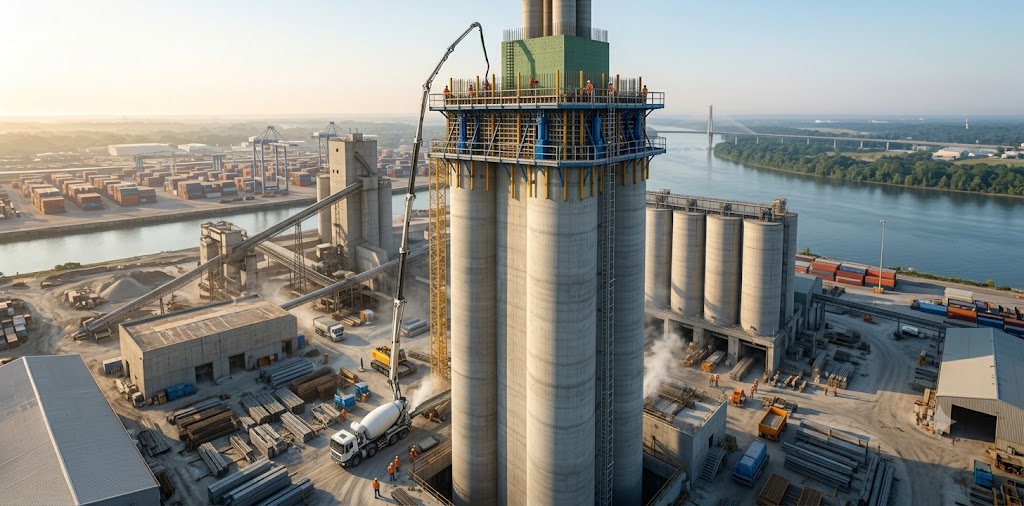
For commercial contractors and infrastructure developers, selecting a formwork system requires balancing upfront mobilization costs against long-term site savings. Here is why slipforming is often the most financially viable choice for major projects:
Traditional jumpform or timber formwork requires pouring, curing, stripping, cleaning, and resetting. This cycle can take days per floor or lift. Slipform eliminates non-productive transition times entirely. By operating continuously, structures like silos or high-rise cores can rise by 3 to 6 meters per day, drastically shortening the critical path of the project schedule.
Because the concrete is placed continuously, slipform construction significantly reduces or eliminates construction joints (cold joints). This results in a seamless, monolithic concrete structure that boasts superior watertightness, enhanced resistance to environmental weathering, and excellent structural load distribution. This is a critical selling point for projects like liquid storage tanks, silos, and marine structures.
While slipforming requires highly skilled supervisors, it reduces the overall manpower needed for stripping and re-erecting traditional shuttering. Furthermore, because the working platforms and guardrails are integrated into the self-climbing system, the risk of falls from height is dramatically mitigated compared to conventional scaffolding set-ups.
With a fixed, reusable formwork system, timber waste on-site is virtually eliminated. Material delivery (concrete and rebar) is scheduled at a steady, predictable cadence, reducing congestion on tight urban jobsites and allowing for leaner supply chain management.
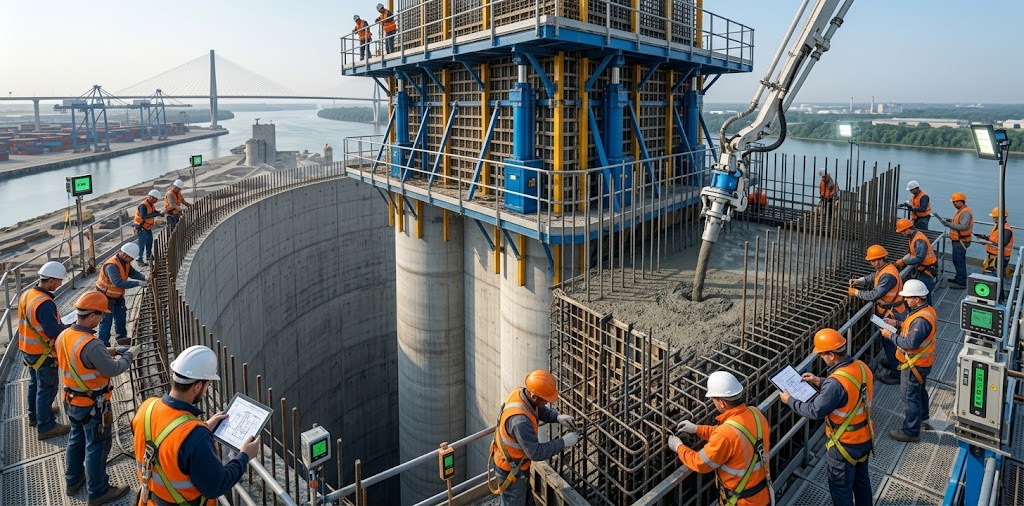
Despite its massive financial and operational benefits, slipform construction is an exacting science. B2B decision-makers must evaluate several critical factors before deployment:
The success of a slipform pour relies heavily on the chemistry of the concrete. The mix must remain workable enough to be placed and vibrated, yet set quickly enough to support the structure as it leaves the mold. Contractors must closely monitor:
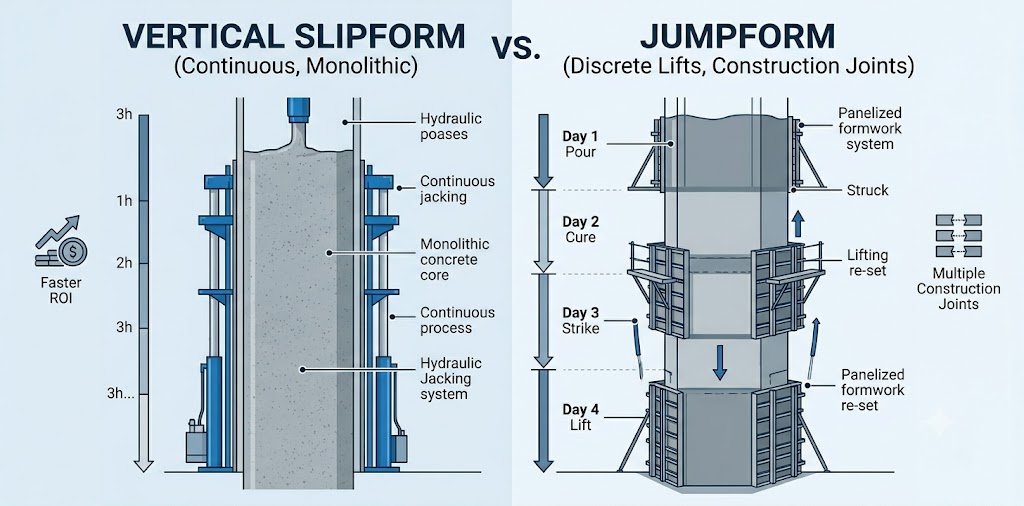
|
Feature |
Slipform Construction |
Jumpform / Climbing Form |
Traditional Timber/Panel Form |
|
Movement |
Continuous (Slow & Steady) |
Intermittent (Stepped Lifts) |
Manual Strike & Re-erect |
|
Speed of Construction |
Extremely Fast (3-6m/day) |
Moderate (1 lift every few days) |
Slow |
|
Construction Joints |
None to Minimal |
Frequent (At every lift) |
High |
|
Initial Capital Investment |
High |
Medium-High |
Low |
|
Ideal Project Profile |
Tall, uniform structures (Silos, Cores) |
High-rise residential/commercial |
Low-rise, complex geometry |
Slipform construction represents the pinnacle of concrete engineering efficiency. For B2B construction firms, infrastructure developers, and material suppliers looking to scale up productivity, it offers a proven method to slash project timelines, lower long-term labor costs, and deliver structures of superior monolithic strength.
While it demands meticulous planning, precise concrete mix management, and a higher upfront investment, the ROI achieved through compressed schedules and minimized on-site overhead makes it an unbeatable choice for the right asset class.
Are you planning your next high-rise development or infrastructure project? Choosing the right formwork strategy can optimize your budget and secure your timeline.
[Contact our engineering team today] to request a comprehensive technical consultation and find out how our premium formwork solutions can streamline your next build.
Email : aj-steven@dghualifeng.com.cn


Friendly Links :
Kitchen Cabinet© 2026 Guangzhou AJ Building Material Co.,Ltd All Rights Reserved

 en
en fr
fr es
es