Single vs Double Scaffolding: The Ultimate Guide for Construction Projects
Jun 11, 2026When executing any construction, maintenance, or renovation project, safety and efficiency are paramount. At the heart of these priorities lies the selection of the right temporary support structure: scaffolding. While there are numerous types of scaffolding systems available today, two fundamental configurations remain industry staples—single scaffolding and double scaffolding.
Choosing the wrong type can compromise worker safety, lead to project delays, or incur unnecessary rental and labor costs. In this comprehensive guide, we will break down the structural differences, ideal use cases, safety profiles, and cost implications of both systems to help you make an informed decision for your next project.
Single scaffolding is a traditional system primarily used for brick masonry work, which is why it is widely known as bricklayer's scaffolding.
The defining characteristic of single scaffolding is its reliance on the building's existing wall for structural support. It consists of a single row of vertical standards (uprights) placed parallel to the wall, positioned roughly 1.2 to 1.5 meters away.
Standards: Vertical poles anchored to the ground.
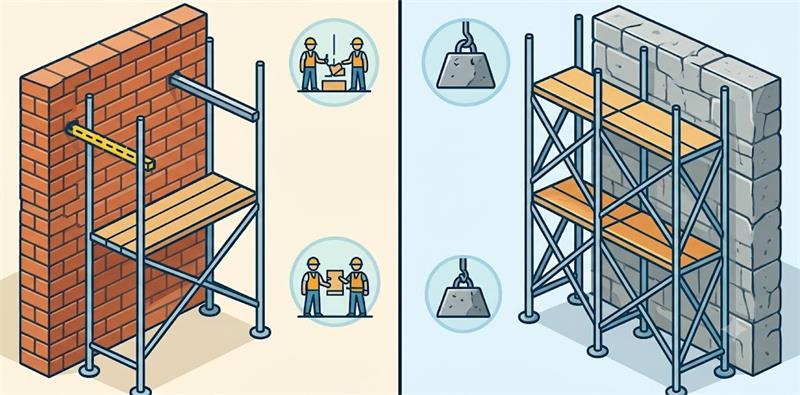
Unlike its single counterpart, double scaffolding is entirely independent of the building's walls for vertical load support. For this reason, it is frequently referred to as mason's scaffolding or independent scaffolding.
Double scaffolding consists of two rows of vertical standards. The first row is placed close to the wall (around 20 to 30 cm away), and the second row is placed parallel to the first, roughly 1 meter to 1.2 meters further out.
To help you quickly evaluate which system aligns with your current inventory or project requirements, let's compare them across critical operational matrices:
|
Feature |
Single Scaffolding (Bricklayers) |
Double Scaffolding (Masons) |
|
Wall Dependency |
High (Requires putlog holes in the wall). |
None (Completely independent/freestanding). |
|
Row of Standards |
Single row. |
Double row (Inner and Outer). |
|
Load Capacity |
Light to Medium duty (Best for workers and light materials). |
Heavy-duty (Can support stone blocks, heavy tools, and multiple workers). |
|
Primary Material Compatibility |
Brick masonry. |
Stone masonry, structural glazing, concrete repair, and cladding. |
|
Installation Speed |
Faster setup and teardown, fewer components. |
Slower setup, requires more precision, and components. |
|
Surface Impact |
Leaves holes that require subsequent patching. |
Non-invasive; leaves the facade completely untouched. |
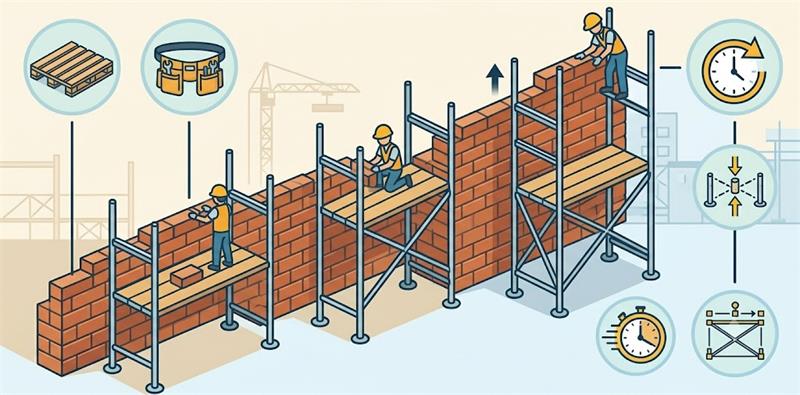
Single scaffolding is highly efficient under the right conditions. It is the optimal choice when:
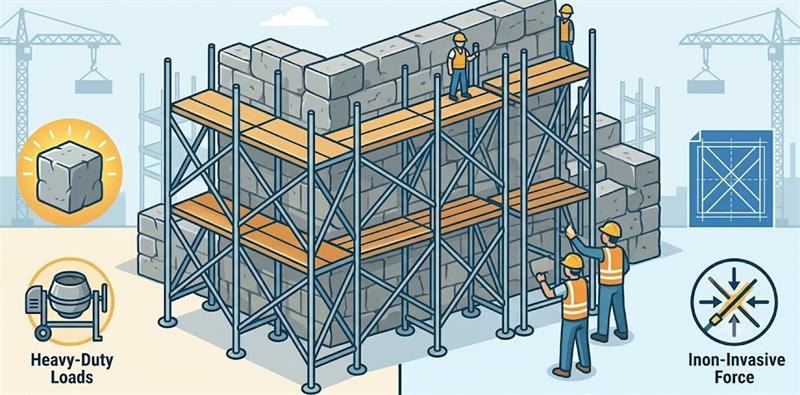
Double scaffolding is the industry standard for complex engineering and heavy-duty structural work. You should opt for this system when:
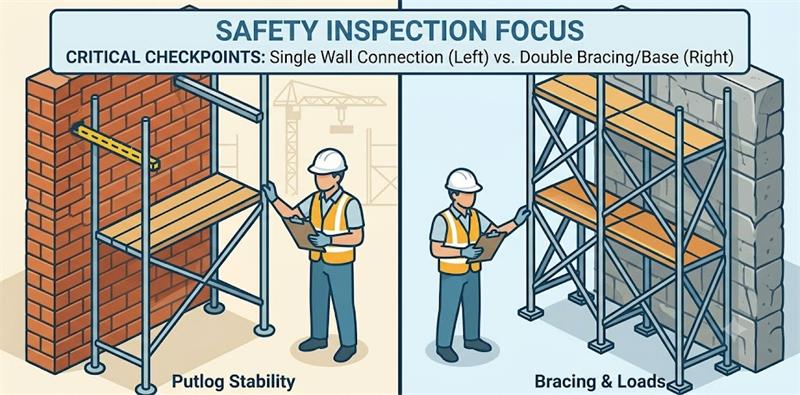
Regardless of the system you select, compliance with local safety regulations (such as OSHA or EN standards) is non-negotiable.
For Single Scaffolding: The critical safety vulnerability lies in the wall connection. If the putlogs are not firmly seated or if the brickwork is unstable, the system can fail. Regular inspections are required to ensure the wall holes have not degraded.
For Double Scaffolding: Stability hinges on correct diagonal bracing and ground conditions. Because it carries significantly higher loads, the sole boards (mud sills) must be properly bedded on stable, compacted ground to prevent sinking.
In the debate between single vs double scaffolding, there is no single winner—only the right tool for the specific application. Single scaffolding offers unparalleled cost-efficiency and speed for standard brickwork. Conversely, double scaffolding provides the robust stability, heavy load-bearing capacity, and non-invasive access required for stone masonry, structural glazing, and high-rise renovations.
For scaffolding procurement managers, project engineers, and equipment distributors, optimizing your inventory with a balanced mix of both configurations ensures you can meet any structural challenge safely and cost-effectively.
Looking to upgrade your project safety or expand your scaffolding rental inventory? We supply premium-grade, certified scaffolding components—from heavy-duty standards to high-tensile couplers—tailored to meet the rigorous demands of modern construction.
[Contact our engineering team today] for a customized quote or to discuss the ideal scaffolding configuration for your upcoming project.
Email : aj-steven@dghualifeng.com.cn


Friendly Links :
Kitchen Cabinet© 2026 Guangzhou AJ Building Material Co.,Ltd All Rights Reserved


 en
en fr
fr es
es