Can Acrow Props Be Used Permanently? A Comprehensive Guide to Structural Safety
Mar 31, 2026The Acrow prop, also known as an Adjustable Steel Prop, is an unsung hero in the construction and renovation worlds. These telescopic steel supports provide much-needed stability to a building while the work is being completed. They assist in large tasks such as supporting a lintel while the wall is being removed, or shoring up a sagging floor joist.
One common question asked by property owners and junior site managers alike is whether Acrow props can be used as a long-term solution for structural issues.
Many people are tempted to leave an acrow prop in place as a quick fix for a problem with their building's stability, but the short answer is no. Acrow props were only meant to be temporary supports. Using an Acrow prop as a permanent structural support creates serious safety risks and will leave you liable for any resulting damage!
Here, we will discuss the engineering design purpose of these devices, the dangers of using them for prolonged periods, and the guidelines for use that you need to know to maintain safety on your construction site.
To understand why Acrow props cannot be used permanently, we must look at their engineering. According to international standards such as BS 4074 or EN 1065, adjustable steel props are categorized as "temporary work equipment."
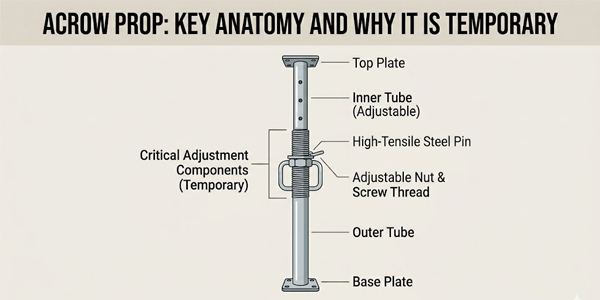
Choosing the correct prop is critical for safety, even if it is being used temporarily. A structural failure is commonly caused by using a prop at a height or load other than what it is designed to support. It is essential to know and follow the standard industry specifications outlined below.
|
Prop Size |
Min. Height (m) |
Max. Height (m) |
Approx. Weight (kg) |
|
Size 0 |
1.041 |
1.829 |
13.5 |
|
Size 1 |
1.753 |
3.124 |
18.0 |
|
Size 2 |
1.981 |
3.352 |
20.0 |
|
Size 3 |
2.590 |
3.962 |
23.0 |
|
Size 4 |
3.200 |
4.876 |
28.5 |
It is a common misconception that a prop's strength is constant. The strength of a prop (the amount of load it can safely hold) is actually reduced as it is extended away from its minimum height. A Size 1 prop that can safely hold a huge amount of weight/speed at its minimum height has far less capacity when it is fully extended because there is a greater chance of that prop "buckling".
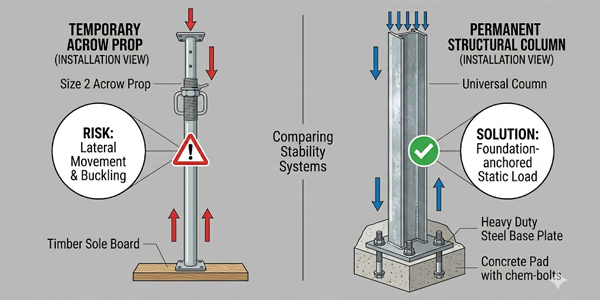
Leaving an Acrow prop in place permanently (e.g., in a basement or garage) introduces several hazards that could lead to catastrophic failure.
The acrow prop is created to be able to have the ability to hold vertical load (axial) loads. The lateral (side) forces apply very little resistance, and in a permanent structure that is impacted by a vehicle, or the earth is shifting, that could cause the prop to kick out from under the load and result in the immediate collapse of the load-bearing structure.
In a moist environment (basement), the threaded portion of the prop that provides structural integrity can be subjected to rusting because of the moisture in these environments. A permanent steel column, typically bolted or welded into the substrate, can be adjusted and/or inspected for internal structural thinning. A prop that has rusted cannot be adjusted, nor does it have a means by which to visually inspect for internal structural thinning.
In order for permanent columns to support their loads, they typically need a "pad foundation" to distribute their weight into the ground. Acrow props are typically supported on small base plates and, over time, from the concentrated point load, may result in cracking of the concrete floor or sinking of the prop into the sub-base, resulting in an inability to provide support.
If you have a project where an Acrow prop has been in place for more than six months, it is time to transition to a permanent solution. This usually involves:
For the duration that the props are in use, strict maintenance is required:
While Acrow props are indispensable for construction, they are not a substitute for permanent engineering. Using them beyond their intended temporary lifespan bypasses building regulations and creates a "ticking time bomb" within the structure.
Whether you are a building contractor or a materials distributor, adhering to the temporary-use-only rule is non-negotiable for site safety and professional integrity.
Are you planning a complex structural project? Don't leave your safety to chance. Contact our technical team today for a consultation on the right shoring equipment for your site, or browse our range of high-performance, certified Acrow props and formwork solutions.
Tags :
Email : aj-steven@dghualifeng.com.cn


Friendly Links :
Kitchen Cabinet© 2026 Guangzhou AJ Building Material Co.,Ltd All Rights Reserved

 en
en fr
fr es
es