The structural soundness of temporary support systems is unarguably one of the most important factors to consider when working on large-scale construction and industrial infrastructure. Within every scaffolding system, there are pipes used for support. Knowing what size and weight capacity your scaffolding pipe will be able to safely hold is critical to providing safe work environments, maximising your material utilised on-site, and achieving compliance with the international engineering standards.
This guide outlines exactly what things are taken into consideration when determining how much weight each type/size of scaffold metal pipe can safely support, as well as what standards exist to govern the use of scaffolding pipes in all parts of the world.
1. The Fundamentals of Load Capacity
How much weight can be supported by the scaffolding pipe? The Load Capacity is found by determining how much load (force) a given scaffolding pipe can bear before it reaches its Limit-State of being permanently deformed or physically collapsing. In the professional Engineer aspect of your job, this value is always calculated in relation to all other pipes in a given scaffolding grid; this means you cannot just use this value by itself.
Dead Loads vs. Live Loads
- Dead Loads: The self-weight of the scaffolding structure (i.e., the weight of the pipes, steel planking, steps, and couplings that make up the actual scaffolding).
- Live Loads: The combined weight of all persons, equipment, and materials being stored on the scaffolding framework.
2. Key Determinants of Structural Strength
The load-bearing potential of a scaffold tube is dictated by several physical and mechanical properties.
A. Specification of Material and Thickness of Wall:
- The material most often used for structural scaffolding is galvanised carbon steel, and the thickness of the wall (typically 3.2mm or 4.0mm) has a direct impact on how much bending moment the pipe can withstand. A thicker wall gives an increase in the cross-section of the pipe and therefore gives an increase to the axial load bearing capacity.
B. The Slenderness Ratio and Buckling:
- As the unsupported length of a pipe increases, the strength of the pipe decreases due to being slender. This is referred to as the slenderness ratio in engineering. A pipe may be made from a strong material, but if the vertical lift height between the two horizontal ledgers is too great, the pipe could buckle when loaded to less than its theoretical crushing load.
C. Regulatory Standards: EN39 and BS1139
Compliance with international standards ensures consistency in performance.
- Our commercial and technical stock includes conventional steel tubes to BS1139 / EN39. These are available in straight lengths and have a nominal outside diameter of 48.3mm with a diameter tolerance. The steel has a minimum specified yield strength of 235 N/mm2. The use of these components as a base for safe load calculations is a common starting point.
3. Load Classes and Duty Ratings
Scaffolding systems are classified based on their intended application. These classifications dictate the maximum Uniformly Distributed Load (UDL) allowed on the working platforms.
|
Load Class
|
Rated Capacity (UDL)
|
Application Profile
|
|
Class 1 (Extra Light)
|
0.75 kN/m2
|
Inspection and very light maintenance.
|
|
Class 3 (General Purpose)
|
2.00kN/m2
|
General construction and bricklaying.
|
|
Class 4 (Heavy Duty)
|
3.00kN/m2
|
Masonry, concrete work, and heavy loading.
|
4. Engineering Calculations for Load Capacity
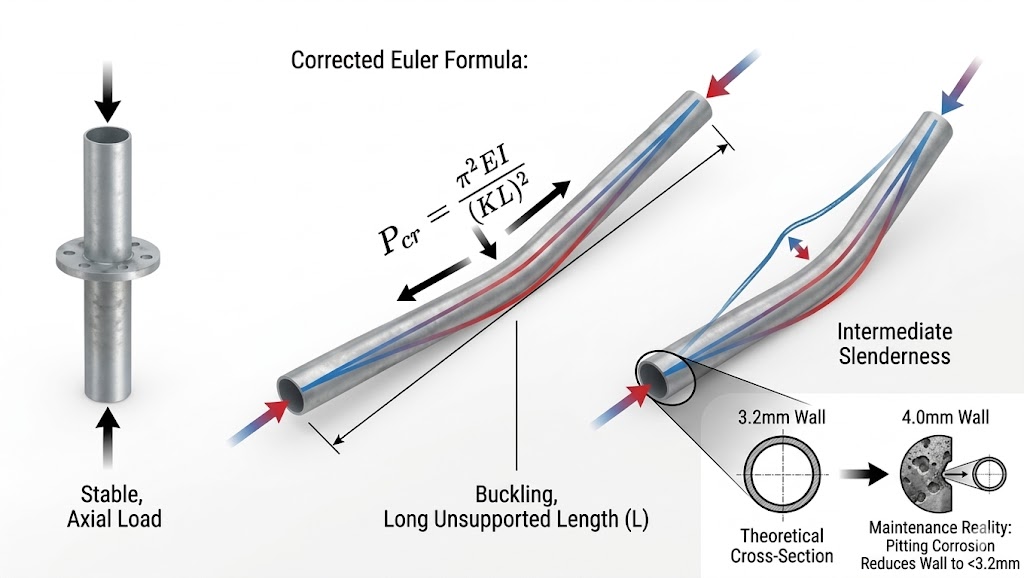
Calculating the critical load of a vertical scaffold standard (acting as a compression member) involves assessing Euler’s buckling formula.
The critical buckling load Pcr is expressed as:
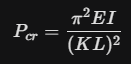
Where:
E: Modulus of elasticity of the steel.
I: Second moment of area.
L: The actual length of the pipe.
K: The effective length factor (dependent on how the ends are secured).
The Safety Factor: To account for unpredictable variables such as wind oscillation or minor material defects, a safety factor (typically 4:1) is applied to the ultimate breaking load to determine the Safe Working Load (SWL).
5. Factors That Diminish Load Capacity
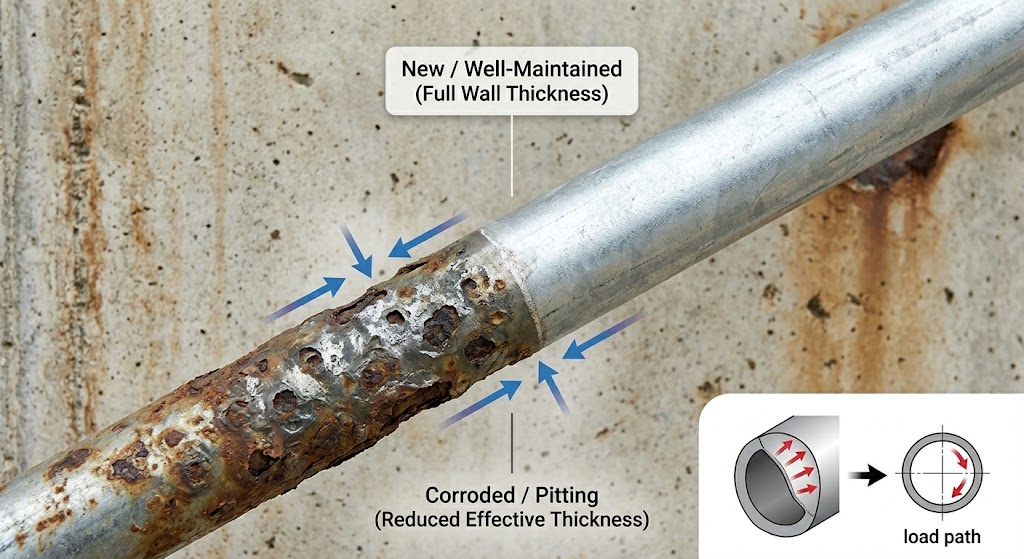
Theoretical capacity must be adjusted for real-world conditions. Over time, several factors can compromise the integrity of the steel:
- Corrosion/Oxidation: When deep rust is present on the pipe, the effective thickness can be greatly reduced to the point where, for both static and dynamic loads, the pipe's inertia can be dramatically decreased.
- Eccentric Loading: An eccentric loading is defined as a loading where the center of loading is not directly above the center of the pipe. In this type of loading, there is an additional bending stress imposed on the pipe. This changes the point of failure from the hoop stress break point to the bending stress break point.
- Physical deformation: Dents, bends, and 'straightened' pipes cannot be repaired and should be taken out of service as they will not have met the original performance criteria.
6. Practical Implementation for Site Safety
To maintain the highest standards of structural integrity, consider the following technical practices:
- Uniformity of Materials: Avoid mixing tubes of different wall thicknesses (e.g., 3.2mm and 4.0mm) within the same vertical run to ensure predictable load distribution.
- Rigid Coupling: Ensure all couplers are torqued to the manufacturer’s specifications, as the "fixity" of the joints affects the $K$ factor in buckling calculations.
- Regular Verification: Conduct periodic thickness testing and straightness checks to ensure that the inventory still meets the original mill certificate specifications.
Conclusion
Determining scaffolding pipe load capacity is a balance of material science and mechanical engineering. By adhering to recognized standards like BS1139 and EN39, and factoring in variables like slenderness ratios and safety margins, construction projects can proceed with the highest level of structural confidence.
Safety in scaffolding is not a matter of guesswork—it is a matter of calculated precision.
Ensure your next project is built on a foundation of certified strength. We provide premium, high-strength scaffolding pipes and components that exceed international safety standards.
Contact us today to receive full technical specifications and mill certificates for your scaffolding requirements!
FAQ
1. What is the standard load capacity of a 48.3mm scaffold tube?
- The load capacity of a standard 48.3mm outside diameter (O.D.) scaffold tube depends primarily on its wall thickness and its unsupported length. For a standard 4.0mm wall thickness steel pipe complying with EN39, the safe axial load is typically around 40 kN to 60 kN, provided the unsupported height (lift) is kept within standard limits (usually 2.0 meters). However, this value decreases significantly as the lift height increases due to buckling risks.
2. How does wall thickness (3.2mm vs. 4.0mm) affect load-bearing?
- Wall thickness is a critical factor in structural stability. A 4.0mm pipe has approximately 20% more steel than a 3.2mm pipe. This extra material significantly improves the Radius of Gyration and the Moment of Inertia, making the 4.0mm pipe much more resistant to buckling. In heavy-duty applications or high-clearance structures, 4.0mm pipes are the industry preference to maintain a higher safety margin.
3. Can rusted or corroded pipes still meet load requirements?
- Corrosion is a "capacity killer." Surface rust (flash rust) typically doesn't affect structural integrity, but pitting corrosion or internal scaling reduces the effective wall thickness. If a pipe’s wall thickness has decreased by more than 10% from its original specification, it should be downgraded or decommissioned, as it can no longer reliably meet the load capacities defined in standards like BS1139.



 en
en fr
fr es
es