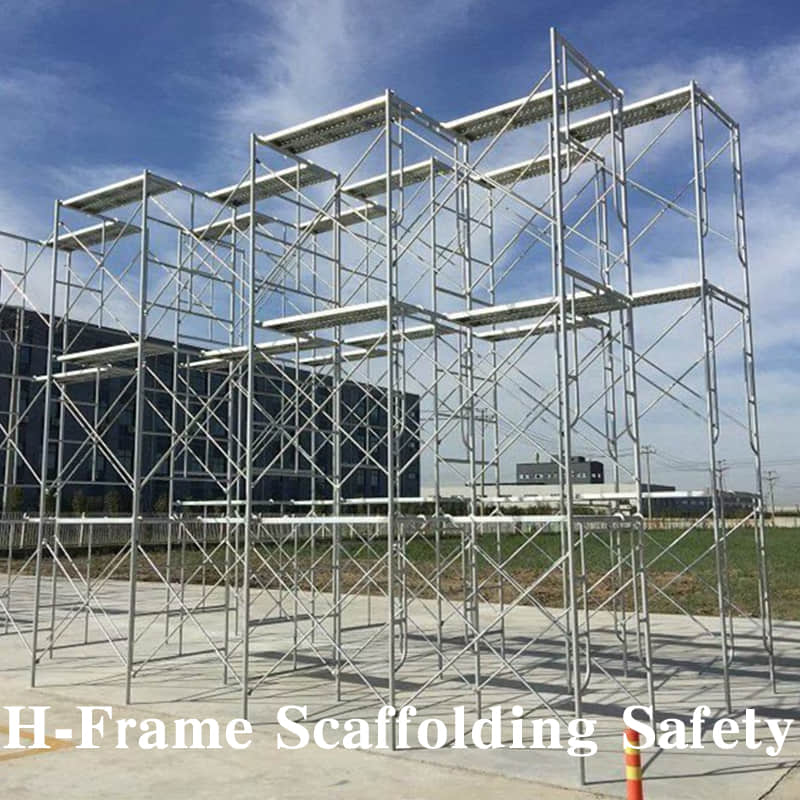
• H Frame Scaffolding Safety: Building a Secure Foundation for Work at Height
    H Frame Scaffolding Safety: Building a Secure Foundation for Work at Height Jun 09, 2025
    H frame scaffolds are commonly found on construction sites around the world and are strong and flexible options for working at heights. H-frame scaffolds are shaped like an H with a vertical frame and horizontal cross braces that provide stability and load capability. There are risks to working at height. Making sure H-frame scaffolds are safe is not just a legal requirement, it is necessary to protect the lives of workers and prevent injuries. This blog post will outline the most important aspects of H-frame safety, outlining best practices for the use of H-frame scaffolds, common hazards and the way to follow standards in creating a safe place to work.   Key Components of H Frame Scaffolding   H-Frames (vertical support) Cross Bracing (lateral stability) Platforms/Planks (working surface) Base Plates/Mud Sills (foundation) Adjustable Screw Jacks (leveling) Guardrails and Toe Boards (fall protection) Ties and Anchors (securing to structures) Ladders/Access Systems (safe ascent/descent)       Essential Safety Practices for H-Frame Scaffolding     Safety on H-frame scaffolding requires meticulous planning, precise execution, and constant vigilance. Adhering to key safety practices from planning through daily operations is crucial.   Setting the Safety Foundation: Before lifting the first frame, a comprehensive planning process is essential: - Site Evaluation: Characterize the work site, including ground conditions, overhead hazards (power lines), obstacles, and uneven or sloped ground. - Load Capacity Calculations: Always calculate the maximum intended load, including the workers, tools, scaffolding, and materials, based solely on manufacturer specifications and applicable rules and regulations; never exceed any of those limits. - Weather Conditions: Consider possible weather conditions that would halt work due to high winds, water infiltration, snow, ice, etc. It may be in everyone's best interest to stop work if conditions become unsafe.   Building and Dismantling: There are many safety hazards that may occur working with the assembly and disassembly of scaffolding and failures can happen when the correct procedures are not followed: - Competent Person: EVERY assembly and disassembly task has to be completed with the supervision of a "competent person." - Compliance to Standards: All assembly or disassembly MUST be conducted in accordance to the manufacturers instructions and industry standards such as OSHA, ANSI or CSA Z797. - Sequence of Assembly and Bracing: If scaffolding components are to be erected in the proper sequence, the workers assembling the structure must ensure diagonal and horizontal cross bracing are also installed to ensure all frames are properly braced. - Building Plumb (Vertical), Level (Horizontal) and Square (Right Angles): The height, level, and square of scaffolding must always be adhered to ensure it remains stable and safe. - All Connections Properly Secured: All connections such as pins, couplers, and locking controls, must put together and secured as designed and intended. - Fall Protection: All workers must wear personal fall arrest systems (PFAS) or temporary guardrails, when erecting, or dismantling the scaffold.   Inspection and Maintenance: Safety is a continuous process; repeated inspections and timely maintenance are important: - Pre-Use Daily Inspections: Most of the time inspections can be fairly quick but must be thorough. The very first thing you must do every day is inspect the scaffold before the workers access it. - Regular Inspections by a Competent Person: The designated competent person must complete more detailed inspections at regular intervals (e.g. once a week, after significant wind events, after modifications, etc.), and will be documented. - Inspection of Damage or Loose Connections: The competent person should be looking for bent frames, damaged braces, corrosion, or any loose pins and couplers. - Repair or Replacement of Any Damage/Defective Part immediately: Any damaged or defective part must immediately be taken out of service (removed for currency), repaired, or replaced with compliant parts. - Clean Platforms: ALWAYS keep the platforms free from debris, unnecessary tools, and materials to eliminate trip hazards.   Safe Usage and Operations: After inspection and assembly, the safety of the scaffold is entirely dependent upon how the scaffold is used: - Never exceed the load limits: This is the most important. Always monitor the load of workers, tools, and materials on the scaffold. - Keep the work platform clean and properly organized: Keep the path to travel clear, store tools securely when not in use, and remove waste and materials promptly. - Access and egress: Always use the designated access and egress, such as a ladder or stair tower that is secured and attached. - Secure tools and materials: Use tool lanyards whenever possible; if materials are hoisted, hoist them with care. Also, check that have everything on the platform secured to prevent them from falling. Having toe boards installed is an essential factor of control on the platform. - Implement fall protection: Guardrails with a top rail, mid-rail, and toe board will always be the primary form of fall protection. If guardrails cannot be implemented, PFAS shall be used. - Beware of overhead electrical lines: Identify every powerline above your work station before starting, then follow the minimum clearance distance from every overhead powerline primary connect uncontrolled; - Stop work during inclement weather: If high winds, heavy rain, thunder and lightning, snow, or ice create unsafe operating conditions, everyone shall stop whatever work they are doing on the scaffold. Work will only resume after a competent person has re-inspected the scaffold.       Common Hazards with H-Frame Scaffolding   - Falls from Height: o No guardrails or improperly installed guardrails. o Platforms/planking unsecured or damaged. o Improper access for people (climbing cross braces). o Slippery surfaces.   - Scaffold Collapse/Structural Failure. o Exceeding load capacity of scaffold. o Improper erection or bracing. o Inadequate foundation (sloped or unstable ground, no mud sills/base plates). o Damaged components. o Lack of ties to structure (if scaffold exceeds certain height).   - Falling Objects: o Tools, materials, or debris on platforms that are not secured. o Toe boards or debris netting not used.   - Electrocution: o Working near overhead power lines. o Contact with electrical equipment that is energized.   - Severe Weather: o High winds, that can cause instability. o Rain, snow, or ice; causing slippery surfaces.       Training and Competence:   Safety with H-frame scaffold hinges on training and competence. Safety regulations are worthless to the health and safety of workers unless workers understand them and apply them. Everyone who is involved with the scaffolding will require training, from the person who erects and disassembles the scaffolding to the person who uses the scaffolding, and everyone who inspects and uses scaffolding from day to day, as scaffold use is not limited to construction worker. Training should include scaffolding erection techniques, scaffolding disassembly procedures, inspection for compliance, identifying common hazards, using fall protection systems properly, and emergency procedures. Most importantly, training defines who a competent person is, in that a competent person is able to recognize hazards and take corrective action because they have the knowledge, training and authorization to do so. A competent worker is quintessential to a sound safety plan; without well-trained and competent workers, even the most safety inspired plans will fail.     Regulatory Compliance and Standards   Compliance with established regulatory compliance and standards is more than a legal obligation; it is the essential foundation of H-frame scaffolding safety. Regulatory compliance and standards from governing bodies and industry groups provide the basic framework for the safe practice of working at height. In the USA, OSHA (Occupational Safety and Health Administration) 29 CFR 1926 Subpart L outlines requirements for scaffolding as it is used in construction. In Canada, CSA (Canadian Standards Association) Z797 outlines similar exhaustive requirements. However, it is always recommended to follow explicit instructions provided by the manufacturer as the primary source of reference due to variations in scafold systems. Following these regulations will not only ensure you are on the right side of the law, but just as importantly, it will provide a consistently safe working environment for all members of the workforce at height.       Conclusion   In summary, H-frame scaffolding safety is a non-negotiable aspect of any construction or maintenance project involving work at height. From the initial planning and precise erection to diligent daily inspections and responsible usage, every step plays a vital role in preventing accidents and safeguarding lives. By embracing proactive safety measures, ensuring comprehensive training, and strictly adhering to regulatory standards, companies can transform potential risks into secure and efficient elevated workspaces. Prioritizing safety isn't just about compliance; it's about fostering a culture where every worker feels secure, leading to a more productive, efficient, and ultimately, a more human-centered work environment. Stay vigilant, stay safe, and build on a foundation of security.       FAQ   Who is responsible for H-frame scaffolding safety on a job site?   Ultimately, everyone involved shares responsibility. However, a designated "competent person" is responsible for supervising erection, dismantling, and inspections. Employers are responsible for providing safe equipment and training, and workers are responsible for following safety procedures.   What should I do if I see a damaged H-frame scaffolding component?   Immediately report the damage to a competent person or supervisor. The damaged component should be removed from service and either repaired by a qualified person or replaced before the scaffold is used again. Never use compromised equipment.     Read More How to Assemble Scaffolding —— YouTube  
  • A Comprehensive Guide to H-Frame Scaffolding Maximum Height and Safety Compliance
    A Comprehensive Guide to H-Frame Scaffolding Maximum Height and Safety Compliance Nov 19, 2025
    In the construction and engineering disciplines, H-Frame scaffolding (also referred to as sectional or frame scaffolding) forms one of two essential building block scaffolds. Simple and quick to erect, this scaffold should form the backbone of any scaffolding inventory. Yet as the tallest structures human beings create reach for the sky, so do the reasons we need to understand the limits to this type of scaffolding. Working without an understanding of height limits brings severe penalties. This guide is aimed mainly at project managers, safety officers, and equipment rental staff to help you understand the limits of H-Frame scaffolding, specifically the maximum height. We’ll cover the regulatory implications and the key things you need to build the world’s tallest structures!       Official H-Frame Scaffolding Maximum Height?     There is no clear-cut maximum height for H-Frame scaffolding. Rather, the safe working maximum can be different based on a cascading list of factors. At the top of that list are regulation and engineering design. 1. Regulatory: The OSHA Standard Here in the US, OSHA sets the basic standard, General OSHA - the rules are sometimes ratio study more than height number study. A key OSHA ratio: For non-mobile, non-supported scaffolds, OSHA usually requires that the height of the scaffold be no more than four times the minimum dimension of the base of the scaffold. The H: B Ratio is typically 4:1. For example, if your short dimension of base is 5 feet wide, look to keep the scaffold 20 feet or less in the air unless it’s tied or braced against that building.   2. Manufacturer Specifications (The Engineering Limit) The most conservative and binding height limit for any specific scaffold system comes directly from the manufacturer's instructions. This specification is based on: Weight Carrying Capacity: The maximum amount that the frames, cross braces, and planks can carry. Material Strength: The yield strength of the steel or aluminum alloy. Workmanship: Especially in the locking pins and coupling devices. A tip for rental companies: Always send along with the equipment the manufacturer’s data sheet that proves the load limits. This limits your liability and gets your customer to take responsibility for not exceeding the engineered limits.     Key Determinants Affecting Maximum Safe Height   Beyond the 4:1 ratio, several dynamic factors must be professionally assessed to calculate the true maximum height for an H-Frame scaffolding system on a specific job site: A. Tie-In and Bracing Requirements When a scaffold exceeds the 4:1 ratio (e.g., typically above 20-30 feet), it must be mechanically secured to the structure being worked on. Tie-In Frequency: OSHA mandates tie-ins at the following intervals: Horizontally: Every 30 feet (9.1 meters). Vertically: Every 20 feet (6.1 meters) for scaffolds 3 feet (0.9 meters) or wider. Vertically: Every 26 feet (7.9 meters) for narrower scaffolds. Anchor Strength: Anchors must be capable of resisting at least four times the maximum intended load applied or transmitted to the tie.   B. Base Plate and Foundation Stability The maximum height can only be determined if the foundation is stable. Firm Footing: All base plates and screw jacks must rest on firm, level, and sound surfaces (e.g., concrete slab, mudsills/sole plates). Leveling: Scaffolding should be plumb and level. The taller the scaffold, the greater the compounding effect of any initial deviation from verticality.   C. Wind and Environmental Loadings High-rise scaffolds are susceptible to strong lateral forces. Some comments as they apply to maximum height calculations for H-Frame scaffolding: Wind Load: Scaffolding located in areas exposed to the wind must be identified in the design pressures calculated from the net pressure from total exposed surface areas, which would include the wind exposure of sheeting and/or netting for containment. For any scaffolding above 60’, the scaffold drawings must be designed or cross-checked and sealed by a P.E. in the state where the project exists. Seismic Activity: In seismic zones, additional diagonal bracing and structural analysis are required to ensure stability.         Best Practices for High-Rise H-Frame Scaffold Management     In order for construction and engineering firms to promote effectiveness and a perfect safety record, the following steps are mandatory when dealing with maximum height applications: 1. Engineering Consultation is Mandatory Any H-Frame scaffolding system over 125 feet (38 meters) high, or not following a manufacturer’s manual for a non-supported design, then a PE will develop a site-specific design, which accommodates tie-in calculations, load evaluations, and foundation requirements.   2. Comprehensive Scaffold Inspection Program A tall scaffold requires constant vigilance. Pre-Shift Check: A competent person must inspect the scaffold before every shift. Post-Modification/Weather Check: Re-inspection after any repair, modification, or high-wind event is essential. Tagging System: Use the standard Green (Safe), Yellow (Caution/Maintenance), and Red (Do Not Use) tag system at all access points.   3. Comprehensive Training The risk of maximum height with H-Frame scaffolding has a direct relationship to the quality of assembly. Ensure your erection and dismantling crew are trained in: Proper assembly sequence (bottom-up) Correct placement of cross-bracing and tie-ins Safe rigging and hoisting practices.     Conclusion   What is the maximum height of an H-Frame scaffolding system? The Maximum height for H-Frame scaffolding is the point of absolute compliance. Feet on the ground, propping you up for the big ascent, the denouement of Propriety, when ably executed. Except for the H-Frame height of a 4:1 ratio or otherwise properly tied. Marshal hurdle, nip and tag, accept scaff tag from the engineer for the big impact design in the high-rise, high-stakes drive.     FAQ   What is the 4:1 rule in scaffolding? The H: B ratio rule states that the scaffold's height must not exceed four times its narrowest base dimension (4:1) without being secured, tied, or restrained to the structure.   When do I need an engineer to approve my H-Frame scaffold? You need to have a Professional Engineer (PE) approve any H-Frame scaffold over 125 feet (38 meters), or complex loading, unique configurations, or heavy containment sheeting are involved.   Can H-Frame scaffolding be placed on soil or grass? Yes, a scaffold can be placed on dirt or grass, if an even load is supplied by using mudsills or sole plates of appropriate size, stable, and under base plates/jacks, to prevent settling and to provide a level foundation.
  • H Frame Scaffolding Load Capacity: Safety, Standards, and Best Practices
    H Frame Scaffolding Load Capacity: Safety, Standards, and Best Practices Dec 09, 2025
    H frame scaffolding (Section/ Masonry Frame scaffolding) is a necessary and common construction scaffolding, providing the required workload, access, and mobility necessary for a variety of construction projects from residential to commercial, through to major public infrastructure. The only thing that is non-negotiable for a construction site to be safe is the scaffolding. The structural integrity of any construction project is based solely on the Scaffolding's Load Capacity. The calculation of the H frame scaffolding Load Capacity can be seen as a legal and moral obligation. If it is overlooked, it will result in the complete structural failure, serious injury, or death. Therefore, this detailed guide, created for Construction Managers, Engineers, and Equipment Rental Companies, details the standards, parameters, and best practices for utilizing H Frame Scaffolding safely.     1. The Core Concepts of Scaffolding Load Capacity   Prior to analyzing a structure's load capabilities, it is essential to create a standard terminology system. A major contributor to extreme overloading of a structure occurs from a misunderstanding of these terms.   Defining Critical Load Terms Working Load (WL), or Permissible Load – The Maximum load (Human, Material, Tools) that the scaffolding was designed and approved to safely support during daily use, is generally derived from dividing the Ultimate Load by the Safety Factor. Rated Load – Refers to a classification of capacity from the manufacturer/design standard. Classifications for rated loads are common in the U.S. and worldwide, and are very often related to the weight distributed per square foot/metre: Light Duty (25lb/ft² / 120kg/m²) = Your working surface should be able to hold that load without being damaged. This requires light-duty ladders, platforms, etc. Medium Duty (50lb/ft² / 24kg/m²) = Your working surface should be able to hold that load without being damaged. This requires heavy-duty ladders, platforms, etc. Heavy Duty (75lb/ft²/36kg/m²) = Your working surface should be able to hold that load without being destroyed. This requires heavy-duty ladders, platforms, etc. Ultimate Load (UL): The theoretical maximum load at which the structure is expected to fail or collapse. This figure is never to be approached in real-world scenarios.   Understanding the Mandatory Safety Factor The establishment of safe scaffolding design is critical to ensure the structural integrity and performance of the scaffolding system. Safety Factor (SF) is the basis for this determination and is defined by both federal (OSHA) and state regulations. SF should ensure that when completing a particular task using scaffolding, the scaffold must be able to safely support at a minimum, its own weight plus four times the maximum intended load.   The 4:1 ratio also creates a safety tolerance for materials used, small variations in setting up the scaffold, and load dynamics. This means the Working Loads for scaffolding will always represent no more than 25% of the scaffold's final rated capacity (Ultimate Load).     2. Key Factors Influencing H-Frame Load Capacity     The actual load capacity of an erected H-frame scaffold is a complex variable, influenced by several interdependent factors far beyond the initial manufacturer's rating. Material Quality and Standards Compliance The core strength relies on the components themselves: Steel Grade: Premium steel tubing, typically verified according to ASTM or other globally recognized standards, guarantees that the material will have consistent strengths. Poorly manufactured or broken materials decrease the ability of the scaffold to carry loads dramatically. Welds & Connections: The strength of the welds in H-Frames and the fit and functionality of the locking pins, springs, and other connection devices must be closely monitored because any failure at that connection could lead to the collapse of the entire frame. Corrosion: As rust or corrosion builds up on steel parts, it decreases the amount of space available for the vertical load. It is therefore essential to routinely examine all steel components for signs of deterioration.   Scaffolding Geometry and Design The way the scaffold is put together dictates its stability and capacity: Height-to-Base Proportion: Taller scaffolds require an adequately sized base or an adequate amount of tie-ins. The structural principle of slenderness states that taller scaffolds with a narrower profile have an increased risk of experiencing buckling/tipping than shorter scaffolds with a wider base. Frame Separation: The space between each of the vertical H-frames (bays) impacts the capacity of the planks and the horizontal members. A greater frame spacing increases the requirement for greater duty-rated materials and will reduce the load that can be supported. Design of Platform: The type of planking (wood/metal) and condition of the planking need to be rated in order to safely transfer the load of the platform to the horizontal members.   Bracing and Tie-in Requirements This is often the most overlooked factor in load-related failures. Cross Bracing and Diagonal Bracing: These components transform the individual frames into a rigid, monolithic structure. They prevent the frames from racking (shearing sideways) under vertical load or lateral wind force. A scaffold without proper, continuous diagonal bracing has a critically compromised load capacity. Tie-ins to the Structure: For scaffolds exceeding a certain height (often four times the base width), they must be securely tied to the permanent building structure. Tie-ins prevent lateral sway and buckling, transferring horizontal wind loads and contributing to overall stability, which is essential for maximizing vertical load capacity.   Foundation and Ground Conditions A scaffold is only as stable as the ground it stands on. Sill Plates and Base Plates: Every leg must rest on a base plate to distribute the vertical load. If the ground is soft, the base plate must sit atop substantial sills (mud sills or sole plates—typically timber) to spread the load over a wider area, reducing ground pressure to an acceptable limit. Soil Bearing Capacity: The soil's ability to resist the scaffold leg's pressure must be assessed. If the soil compresses unevenly, it causes differential settlement, which creates eccentric loading and internal stresses, dramatically reducing the scaffold's safe working load.   3. Efficiency Management / Management Best Practices   How to Estimate Working Load Construction managers must systematically estimate the total load before use: Dead Load: The weight of the scaffold components themselves (provided by the manufacturer/supplier). Live Load (The Load to be Supported): Weight of workers on the platform. Weight of tools, equipment, and materials to be stored or used on the platform. Environmental Loads: Primarily wind loads. High winds can generate enormous lateral (horizontal) forces, which, if not resisted by adequate bracing and tie-ins, can cause racking and failure, even if the vertical load is light. Never rely on guesswork. If the total estimated load approaches the manufacturer's medium-duty rating, consult with a certified scaffold engineer to verify the design and actual capacity for your specific configuration.   The Role of Independent Engineering Assessment For complex, non-standard, or high-rise H-frame scaffold setups, a professional engineer specializing in temporary works must: Certify the Design: Verify that the proposed scaffold design and tie-in plan meet the required load and safety factors. Ground Assessment: Certify the suitability of the foundation and the required size of sill plates. Approve Modifications: Any deviation from the standard manufacturer’s setup (e.g., bridging, cantilevers) must be signed off by an engineer.   Avoiding Common Overloading Mistakes Vertical Material Hoisting: Never use the scaffold structure itself as a primary anchor point for material hoisting equipment unless explicitly designed and certified for that purpose. The load path must be independent. Excessive Material Stacking: Materials should only be stacked in designated, restricted areas and never against the guardrails. A sudden concentration of load can exceed the platform's localized capacity. Non-Uniform Loading: Avoid overloading one section of the scaffold while another remains empty. This creates unbalanced stresses, which can lead to localized failure or instability.     Conclusion   The safe deployment of H-frame scaffolding hinges on a thorough, professional understanding of its load capacity. It is a commitment that extends from the initial engineering design and the quality of the rented equipment to the daily inspections by site supervisors. By adhering to the 4:1 safety factor, meticulously checking bracing and foundations, and maintaining strict load management protocols, construction companies and rental suppliers can ensure their platforms remain safe, compliant, and structurally sound. Safety is not a feature; it is the foundation upon which every successful construction project must be built.     FAQ   What is the main cause of load-related scaffold collapse? The main causes are foundation failure (legs sinking due to poor ground conditions or inadequate sills) and the lack of proper diagonal bracing and tie-ins, which causes the structure to rack sideways.   Can I temporarily exceed the Working Load limit? No. Exceeding the stated Working Load limit, even briefly, compromises the mandatory 4:1 safety factor and creates an immediate risk of catastrophic failure.

Need Help? Chat with us

Leave a Message
If you are interested in our products and want to know more details, please leave a message here, we will reply you as soon as we can.
Submit
Contact us #
+86 -13922304881

Our hours

Mon 11/21 - Wed 11/23: 9 AM - 8 PM
Thu 11/24: closed - Happy Thanksgiving!
Fri 11/25: 8 AM - 10 PM
Sat 11/26 - Sun 11/27: 10 AM - 9 PM
(all hours are Eastern Time)

Home

Products

whatsApp

contact