Modular vs. Tubular Scaffolding: A Practical Guide for Contractors
Aug 07, 2025
Modular vs. Tubular Scaffolding
Choosing the right scaffolding system will be one of the most critical decisions to be made on a new project. It will ultimately affect the schedule, costs, and most importantly, the safety of your workers. There are quite a few options, but for the most part, you will figure your project will come down to one of two main systems, modular scaffolding or tubular scaffolding.
This guide will make a side-by-side comparison that will aid in your decision. It will give the pros and cons of the different types and provide an ideal situation for use in each type to guide you in making the right choice in your next project.
Understanding Tubular (Tube and Clamp) Scaffolding
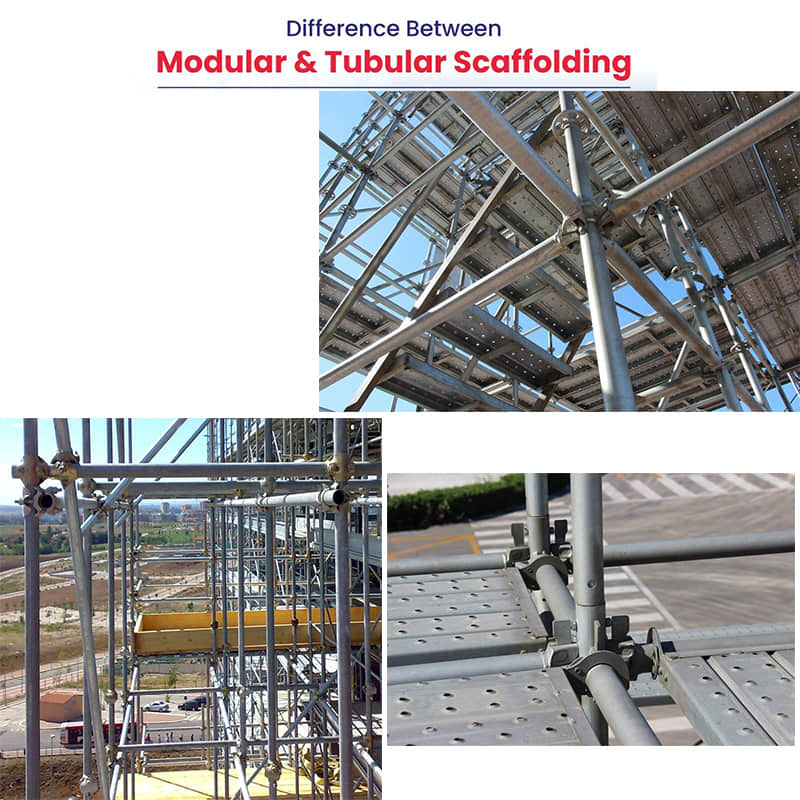
Tubular scaffolding, also called tube and clamp scaffolding, is made up of individual steel tubes that are put together using a variety of couplers and fittings. It is the original type of scaffolding and is recognized for its great versatility.
Key Advantages:
Unmatched Flexibility: The system offers unmatched flexibility in complex shapes. Since all tubes and clamps can be installed independently, you can make a scaffold to fit any shape, inclination, or architectural feature. Tubular scaffolding is the preferred type of system in the restoration of older buildings, bridges, and when there is no way to provide a standard system at an industrial plant.
Cost-effective for Custom projects: While labour costs may sometimes be higher, when it comes to custom projects, the initial material costs for individual tubes and clamps may be less than pre-engineered systems. In jobs where you may have to initiate costly modifications on unique or custom builds, tube and clamp scaffolding may provide you with some savings on labour costs.
Heavy load bearing capability: When properly installed, tube and clamp scaffolding systems are very strong and can be used for heavy-duty applications. It is often the preferred type of scaffolding system when working on jobs requiring heavy materials or equipment.
Key Disadvantages:
Labor-Intensive Assembly: Setting up and taking down a tube & clamp scaffold is labor-intensive. Each component is a standalone piece that has to be clamped and secured. Therefore, the duration of the process takes significantly longer than a modular system. If you're on a busy job site, that extra time to build and take down a scaffold may directly affect your schedule.
Costly Labor: The additional assembly/erection time accounts for additional labor costs. In addition to this, you must have a qualified assembly crew to ensure that the scaffold is assembled and built correctly and safely.
Too Many Parts to Manage: More than just the assembly time and cost, the tubes, clamps, and fittings are all a logistical problem if you're on a busy job site and can potentially create a waste of time if you lose or misplace parts.
Understanding Modular (System) Scaffolding
What It Is: Modular scaffolding, often referred to as system scaffolding (like Ringlock or Cuplock), is a pre-engineered system with standardized, prefabricated components. These pieces feature a fixed locking mechanism that allows for quick and secure connections.
Key Advantages:
·
Time and Efficiency: This is the main advantage of modular scaffolding. The components are designed to be assembled with a simple locking mechanism that can significantly decrease the assembly and disassembly time. More specifically, the benefits of using a more efficient scaffolding system can assist you in keeping your schedule and overall labor costs down.
Reduced Labor Cost: As the components are standardized, with is a lot less training with regard to specialized assemblies which are required when erecting a tubular scaffold. A crew can be trained much more quickly and effectively to build a safe and stable modular scaffold.
Better Safety: The pre-engineered design and the fixed connections result in a system that is much more predictable and consequently stable. There is less reliance on human error when erecting the modular scaffold, and thus, the safety outcome on site is improved.
Best for Standardized Projects: Modular systems are generally your most efficient and cost-effective option where projects are larger, such as high-rise buildings, residential buildings, and where the design layouts are repeating and/or uniform.
Key Disadvantages:
Not as adaptable - Modular systems are not as flexible because connections are fixed to predetermined locations, and objects are prefabricated in a specific design. You will have a harder time framing the scaffold around unique architectural features without having to add material or modify the system.
More expensive up front - Engineered, prefabricated modular scaffolding components might cost more at acquisition or rental than tube materials.
System Lock-in - Once you invest in a specific modular system (e.g., Ringlock), you are often tied to that brand's components, which may limit your flexibility in sourcing equipment.
Difference Between Modular and Tubular Scaffolding
Feature
Modular Scaffolding
Tubular Scaffolding
Assembly Speed
Extremely Fast
Slow to Moderate
Project Flexibility
Limited (best for uniform shapes)
High (can adapt to any shape)
Labor Skill Required
Lower
Higher
Upfront Cost
Higher
Lower (for materials)
Best Examples of Focus
Tall buildings (high-rise), new construction (ground-up), scaling from volume on similar repetitive projects
Historic restoration, industrial plants, complex structures
Safety Profile
High (due to standardized design)
High (when assembled by skilled labor)
Making the Right Choice:
Scenario 1: When building a new 20-story apartment building fastest and most efficient is what is most important. In this situation, modular scaffolding is your best bet. Building the new building with modular scaffolding will be so quick that it will end up saving you a lot of labor costs.
Scenario 2: You are restoring the facade of a historic theatre that is over 100 years old. The facade has complex curved surfaces and cornices with angles throughout. The best option is tubular scaffolding. Tube and clamp scaffolding offers a greater breadth of opportunity to design and build your custom structure based on the unique geometry of the building.
Scenario 3: A small-to-medium-sized residential build. Given a typical project, either could yield the requested outcome. If the crew is experienced with tube and clamp, and you are looking to get costs down for material, tube and clamp could be a viable option, but if you are looking for most efficient for completing project in the least amount of time and that have no certified scaffolding training, I am recommending modular as the best scaffold for efficiency.
Conclusion:
Ultimately, there is no single "better" scaffolding system. The best choice is a strategic decision based on the specific needs of your project.
Choose modular scaffolding when your priority is speed, efficiency, and a large-scale, uniform structure.
Choose tubular scaffolding when your project demands maximum flexibility to navigate complex or unusual designs.
By carefully considering your project's complexity, timeline, and available labor, you can select the right tool for the job, ensuring a safe, efficient, and cost-effective build.
FAQ
1. Is modular scaffolding safer than tubular scaffolding?
Both systems are safe when erected correctly by a trained crew. However, modular scaffolding is often considered to have a safety advantage due to its pre-engineered, standardized components, which reduce the risk of human error during assembly. Tubular scaffolding requires a higher level of skill and experience to ensure all connections are secure and the structure is stable.
2. Which system is more cost-effective?
This depends entirely on the project. Tubular scaffolding may have a lower initial material cost, but the longer assembly time can lead to higher labor costs. Modular scaffolding has a higher initial cost, but its speed and efficiency often result in lower overall project costs, especially for large, uniform structures. You must consider both material and labor costs to determine the most cost-effective option for your specific project.
3. Can you mix modular and tubular scaffolding systems?
No. You should never mix components from different scaffolding systems. Each system is designed with specific engineering standards and safety tolerances. Combining them can compromise the structural integrity and safety of the entire scaffold.
4. What is the difference between Ringlock and Cuplock?
Both Ringlock and Cuplock are types of modular scaffolding. The primary difference is in the connection method. Ringlock uses a rosette with wedge locks that are hammered into place, offering eight connection points per rosette. Cuplock uses a top cup that slides down to secure ledger blades to the standard, creating four connection points. Both are popular, safe, and efficient systems.



 en
en fr
fr es
es