What Is The Most Common Type Of Suspended Scaffold
Jan 14, 2025
In the global construction and high-rise maintenance industries, the most common type of suspended scaffold is the Two-Point Suspended Scaffold, professionally known as a Swing Stage.
This system features a working platform suspended by cables or ropes connected to overhead outrigger beams or rigging structures, powered by manual or electric hoists at both ends. It is widely recognized as the industry standard for skyscraper window cleaning, exterior facade painting, high-rise bricklaying, and concrete structural repair due to its versatility, quick deployment, and robust load capacity.
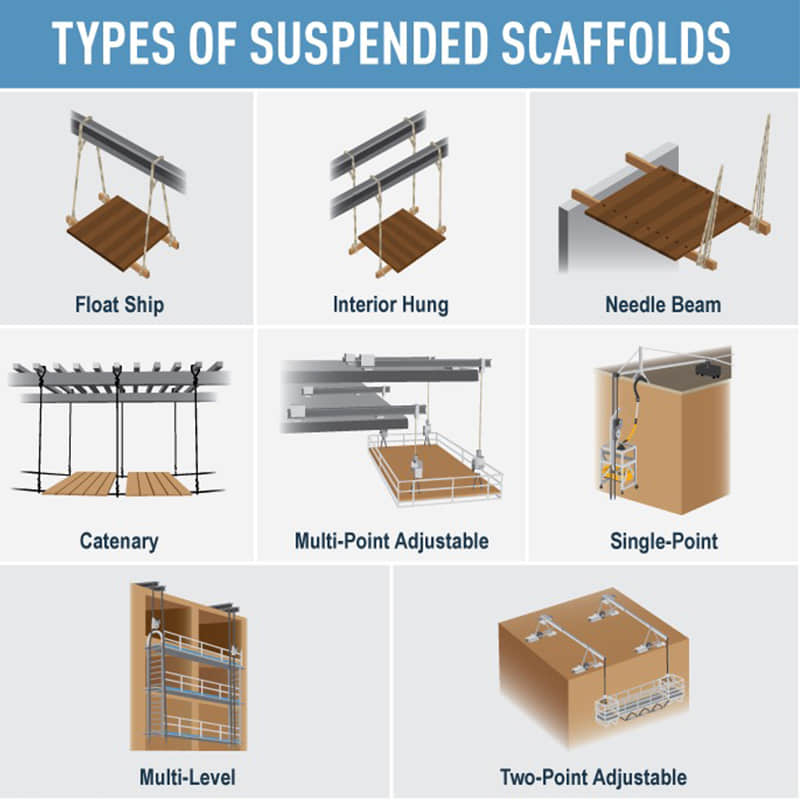
Suspended Scaffold Types
1. Catenary Scaffold
Catenary scaffolding uses steel cables or chains as supports, and the platform is suspended in the air through these supports. Its support system can span a larger span, and the height of the platform can be adjusted, which is suitable for construction tasks that need to cover a large area.
2. Float (ship) Scaffold
Floating scaffolding is usually installed on the water surface, using buoys or other buoyancy devices to keep the platform afloat. The platform is supported by the buoyancy system and can be stably suspended in the water environment.
3. Interior Hung Scaffold
Indoor suspended scaffolding usually uses steel cables or wire ropes to suspend the platform from the top structure of the building. It is very suitable for environments with limited space, and the platform can be flexibly adjusted to meet the needs of operations at different heights.
4. Multi-level Scaffold
Multi-layer suspended scaffolding consists of multiple horizontal platforms, each located at a different height. It is usually equipped with a lifting device that can easily adjust the position of each layer of the platform for operations on high-rise buildings.
5. Multi-point Adjustable Scaffold
This type of scaffolding provides a stable hanging platform through multiple support points, and the height of each support point can be adjusted individually. The platform can be freely adjusted at different heights to meet different construction needs.
6. Needle Beam Scaffold
Structural features: Needle beam scaffolding supports the platform through one or more beams (needle beams), the ends of which are fixed to the superstructure or wall of the building and can bear a large weight. The platform is suspended from these beams to provide a stable working platform.
7. Single-point Adjustable Scaffold
Single-point adjustable suspension scaffolding supports the platform through a single support point (usually a steel cable or wire rope), and the height of the platform can be adjusted by adjusting the support point. This scaffolding has a simple structure and is suitable for a smaller working range.
8. Two-point (Swing Stage) Scaffold
Two-point suspended scaffolding (also called pod scaffolding or basket scaffolding) supports the platform at two points, usually suspended from the building by steel cables or wires. The platform can swing freely in the horizontal plane and flexibly adjust its position.
What Is The Most Common Type Of Suspended Scaffold?
In actual construction, the double-point suspension scaffold (Swing Stage) is the most common and widely used type. Its simple design and low cost make it the preferred equipment for aerial work. In addition, Catenary and Single-point Adjustable scaffolds are also widely used in specific scenarios because of their adaptability and economy.
Two-point (Swing Stage)
Application scenarios: Double-point suspended scaffolding, often called hanging basket or pod scaffolding, is the most common type of suspended scaffolding and is widely used in facade construction, window installation, exterior wall cleaning, painting, and aerial work. Its structure supports the platform through two supporting points, which can provide good flexibility and stability, and is especially suitable for high-rise buildings.
Why it is common: Due to its simple structure, flexible operation, relatively low cost, and strong adaptability, it has become the preferred equipment for high-altitude construction in many construction projects.
Catenary
Application scenarios: Chain scaffolding is mainly used for high-altitude operations that need to span a large area, such as facade construction of bridges, chimneys, high-rise buildings, etc. It can effectively cover a wider area by suspending the platform with steel cables or chains.
Why it is common: It can adapt to large-span operations, and because the height of the platform can be flexibly adjusted, it is often used in complex high-altitude construction tasks.
Single-point Adjustable
Application scenarios: Single-point adjustable suspension scaffolding is mostly used for smaller exterior wall construction, window installation, and cleaning, and is suitable for operations with lighter loads and lower construction heights.
Why it is common: It has a simple structure, is easy to install, and has a low cost. It is especially suitable for quick, small-scale construction and is commonly used in daily facade maintenance and cleaning operations.
The Main Features Of Suspended Scaffolding
Flexibility and adjustability: The suspended scaffolding platform can be adjusted for height and position according to different construction requirements.
Save space: The suspended design takes no space on the ground, making it suitable for construction environments with restricted space.
Quick construction speeds: fast installation and disassembly to enhance construction efficiency and cut down on construction time.
Adapt to other construction environments: it can be adapted to other complex and high-altitude construction environments, such as high-rise buildings and water platforms.
To provide a stable work platform: a safe and stable working platform is ensured by a stable support system.
Large-area operations: can cover a larger operating area, are suitable for multiple people to work on at the same time, and improve working efficiency.
Easy maintenance and inspection: allows easy maintenance and inspection work at heights and in inaccessible areas.
High safety: provided with various safety protection devices enabling safe work at height.
Crucial Safety Requirements for Two-Point Suspended Scaffolds (OSHA Compliance)
Operating platforms hundreds of feet in the air leaves zero room for structural failure. Procurement managers and safety inspectors must ensure that every swing stage setup satisfies global regulatory standards (like OSHA 1926.452 and EN 1808):
The 4:1 Safety Factor: The suspension ropes, outrigger beams, and hoist mechanisms must be engineered to support at least 4 times the maximum intended load.
Independent Fall Arrest Systems: Every worker on a suspended scaffold must be anchored to an independent vertical lifeline using a full-body harness and a rope grab. Never anchor a fall-arrest line to the scaffold platform itself.
Counterweight Calculation: Outrigger beams relying on counterweights must be mathematically calculated to prevent tipping. Tiebacks must be installed perpendicular to the building face as a secondary safety backup.
Key Factors In Choosing Suitable Suspended Scaffolding
Maximum choice of suspended scaffolding ensures safe, efficient, and smooth building construction. The choice is based on some basic considerations:
Construction height and operating range
Construction environment and terrain
Load requirements
Type of assignment
Construction period and installation efficiency
Security
Budget and Cost
Ease of operation
Convenience of maintenance and inspection
Conclusion
If you are a scaffolding rental agency, high-rise construction firm, or building materials distributor, sourcing reliable, field-tested components is vital for your business reputation.
AJ Building is a leading global manufacturer of premium ZLP630 and ZLP800 Electric Suspended Platforms (Swing Stages). Our systems are engineered to withstand the most demanding job site environments:
High-Grade Materials: Available in hot-dip galvanized steel or lightweight, corrosion-resistant aircraft-grade aluminum alloy.
Advanced Safety Locks: Equipped with certified LTD series hoists and LSB anti-tilting safety locks that instantly engage if a steel cable slacks or the platform tilts beyond 3–8 degrees.
Global Certification: Built fully compliant with CE, ISO, and standard safety guidelines.
🏗️ Planning a high-rise project or restocking your rental fleet? Get factory-direct wholesale pricing on standard and customized swing stage systems. [Request a Quote from AJ Building Scaffold Experts Today] for immediate catalog access and engineering support.
FAQ
What Types Of Construction Projects Are Suspended Scaffolding Suitable For?
Suspended scaffolding is suitable for aerial work, facade construction, glass curtain wall installation, building maintenance, painting, and cleaning. The application is thereby appropriate for accessing hard-to-reach areas, such as high-rise buildings, bridges, and water platforms, among others.
Is The Installation And Dismantling Of Suspended Scaffolding Complicated?
Suspended scaffolding is relatively simple to install and dismantle, especially as modern systems are modular in design and can usually be erected and dismantled quickly. Operators need to be trained to ensure that the scaffolding is securely installed and operated in accordance with safety standards.
How Long Is The Maintenance Period Of Suspended Scaffolding?
Maintenance of suspended scaffolding depends on usage, weather, and the type of scaffolding. Usually, support systems, platforms, connecting devices, and safety provisions should regularly be checked. For suspended scaffolding used over longer periods, detailed inspection is a must every 3-6 months; based on this inspection, defective parts must be repaired or replaced.
Read More
Suspended Scaffold Tips----NYC
Suspended Scaffolding Hoists----SWINGSTAGING



 en
en fr
fr es
es