Scaffolding Coupler Types: The Ultimate Guide to BS1139 & EN74 Clamps
Apr 25, 2025Scaffolding fittings are components that join scaffold tubes together. Scaffolding fittings are considered the "working" parts of temporary structures constructed for a particular purpose, whether based around construction, maintenance, repair, or events.
Scaffolding fittings are manufactured from strong materials, commonly galvanized steel or aluminum, so they maintain structural integrity when it is expected to support scaffolders, tools, and materials at heights. It is a flexible building system that is detached and creates an infinite number of uses, and it has been designed to accommodate a pocket of outputs, such as simply renovating a home, developing complex temporary structures for heavy infrastructure building developments, or an outdoor event.
Appreciating the type of application can have a huge impact on project efficiency and worker safety (this is on everybody's mind). Recognising what each fit-out is and the intended use and limits would ensure you safely limit confusion and misunderstandings, and industry regulations compliance.
Swivel couplers join two scaffold tubes with the same compression function as other coupler types, but with the added ability to connect two tubes at any angle. Because of the ability to hook up directly to a diagonal or unconventional connection to the braced structure, swivel couplings are used in almost all scaffolding situations because they can provide secured overall stability to an entire structure. Swivel couplings are usually used as a component of a bracing system.
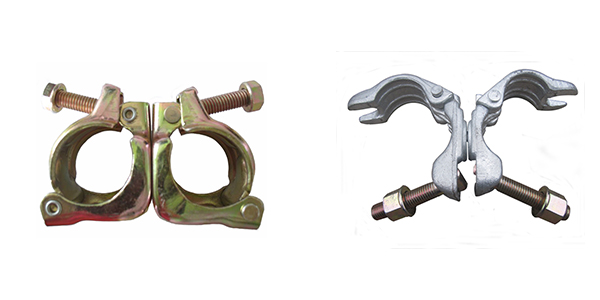
Design: Swivel coupler designed with a pivoting point so that connections can turn on a full 360-degree axis.
Applications: typical on diagonal bracing, or curved scaffold structures, and non-standard scaffold layout.
Benefits: flexibility in design with any project variability.
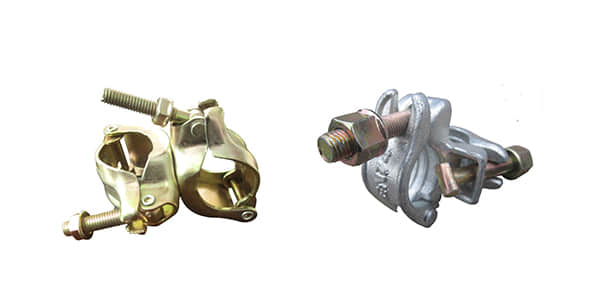
Right-angle couplers, also called double couplers, connect two tubes at a defined 90-degree right angle with a high load capacity, which is why they are a staple of standard scaffolding grids.
Design: Two fixed clamps allow for perpendicular connections.
Application: To connect horizontal ledgers to vertical standards in rectangular structures.
Advantages: High levels of strength and stability for heavy structures.
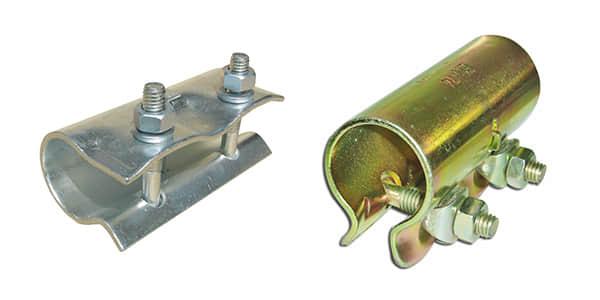
Sleeve couplers connect two tubes from end to end and will essentially extend the length of a tube. They are a must-have when making long runs in large-scaffolding systems.
Design: A tubular sleeve that is fitted over the ends of the tube and fastened with bolts.
Uses: Extending horizontal or vertical tubes in large-scale scaffolding
Benefits: Adding length without loss of strength!
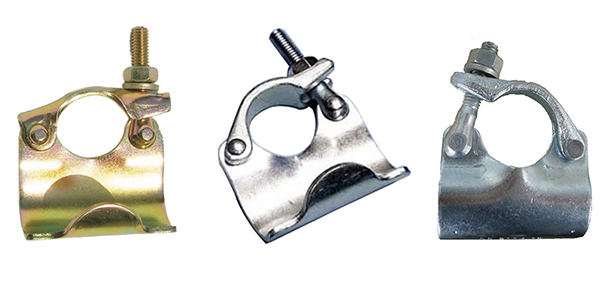
Putlog couplers are used to connect putlog tubes (horizontal supports) to ledger tubes for placing scaffold boards. Putlog couplers are essential when forming a secure working platform.
Design: A single clamp that clamps the putlog tube to the ledger.
Uses: To secure scaffold boards to the main structure.
Advantages: Makes platform assembly easier for safe worker usage.
Beam couplers are used to secure scaffold tubes in place on steel beams, joining scaffolding to existing elements. Beam couplers are commonly used within industrial and infrastructure operations.
Board retaining couplers lock scaffold boards in place, limiting slippage or movement of boards, which is essential for safer platforms.
Joint pin couplers create two tubes that are connected internally end-to-end. They hold the tubing in a straight alignment with no external features to interfere with the overall design. They are used primarily when the connecting area is restricted in space or when there is some other aesthetic-related concern.
Half couplers are a type of coupling that fix one tube to a position (i.e., to a wall or to a column), which provides a secure attachment point for the free end of the scaffold.
Limpet couplers are made of light materials and are intended for low-load applications, such as securing scaffold boards or temporary barriers.
A ladder coupler is used to attach a ladder to a scaffold structure to ensure a means of safe and stable access for workers.
Fencing couplers let you attach mesh, netting, or barriers to scaffold tubes for protective barriers or debris shields.
Scaffolding couplers are the unsung heroes of safe and efficient construction, maintenance, and industrial projects. From the flexible swivel coupler to the sturdy right-angle coupler, each type plays a vital role in creating reliable scaffolding systems. By understanding their applications, prioritizing safety, and committing to regular maintenance, you can maximize their performance and ensure worker safety.
Whether you’re a contractor, project manager, or safety officer, this guide equips you with the knowledge to make informed decisions about these critical components.
Are scaffolding couplers compatible with all scaffold tubes?
Can scaffolding coupler types affect project safety?
What is the difference between Class A and Class B couplers?
Can these couplers be used with both 42mm and 48mm tubes?
Are your couplers Hot-Dip Galvanized?
Seven Fundamental Parts of a Scaffold— Avontus
Scaffolding Parts Explained— Humanfocus
Email : aj-steven@dghualifeng.com.cn


Friendly Links :
Kitchen Cabinet© 2026 Guangzhou AJ Building Material Co.,Ltd All Rights Reserved


 en
en fr
fr es
es