• Modular vs. Tubular Scaffolding: A Practical Guide for Contractors
    Modular vs. Tubular Scaffolding: A Practical Guide for Contractors Aug 07, 2025
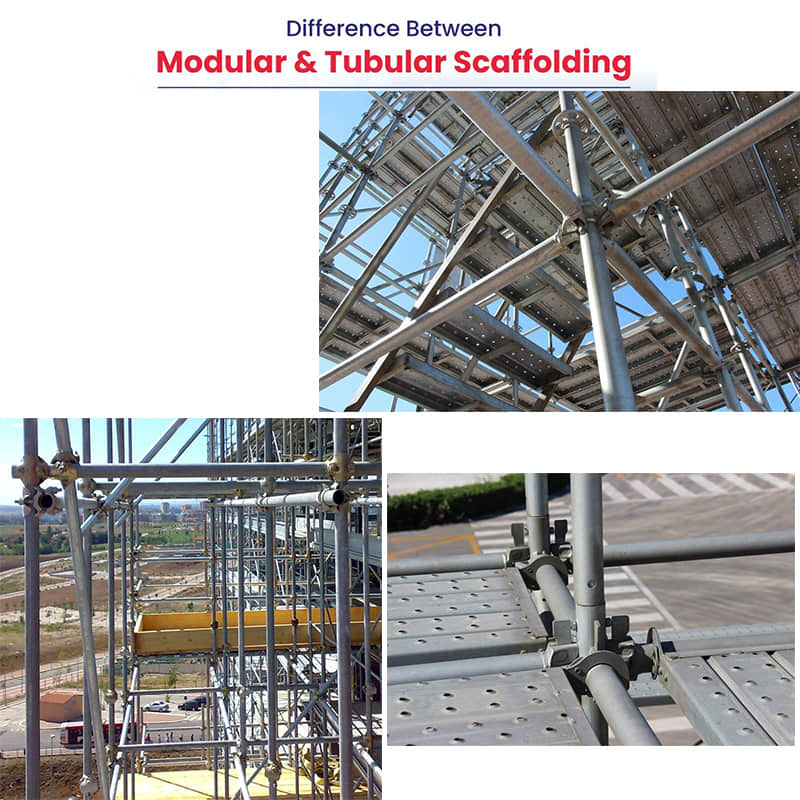
    Modular vs. Tubular Scaffolding     Choosing the right scaffolding system will be one of the most critical decisions to be made on a new project. It will ultimately affect the schedule, costs, and most importantly, the safety of your workers.  There are quite a few options, but for the most part, you will figure your project will come down to one of two main systems, modular scaffolding or tubular scaffolding. This guide will make a side-by-side comparison that will aid in your decision. It will give the pros and cons of the different types and provide an ideal situation for use in each type to guide you in making the right choice in your next project.         Understanding Tubular (Tube and Clamp) Scaffolding   Tubular scaffolding, also called tube and clamp scaffolding, is made up of individual steel tubes that are put together using a variety of couplers and fittings. It is the original type of scaffolding and is recognized for its great versatility.   Key Advantages:   Unmatched Flexibility: The system offers unmatched flexibility in complex shapes. Since all tubes and clamps can be installed independently, you can make a scaffold to fit any shape, inclination, or architectural feature. Tubular scaffolding is the preferred type of system in the restoration of older buildings, bridges, and when there is no way to provide a standard system at an industrial plant. Cost-effective for Custom projects: While labour costs may sometimes be higher, when it comes to custom projects, the initial material costs for individual tubes and clamps may be less than pre-engineered systems. In jobs where you may have to initiate costly modifications on unique or custom builds, tube and clamp scaffolding may provide you with some savings on labour costs. Heavy load bearing capability: When properly installed, tube and clamp scaffolding systems are very strong and can be used for heavy-duty applications. It is often the preferred type of scaffolding system when working on jobs requiring heavy materials or equipment.   Key Disadvantages:   Labor-Intensive Assembly: Setting up and taking down a tube & clamp scaffold is labor-intensive. Each component is a standalone piece that has to be clamped and secured. Therefore, the duration of the process takes significantly longer than a modular system. If you're on a busy job site, that extra time to build and take down a scaffold may directly affect your schedule. Costly Labor: The additional assembly/erection time accounts for additional labor costs. In addition to this, you must have a qualified assembly crew to ensure that the scaffold is assembled and built correctly and safely. Too Many Parts to Manage: More than just the assembly time and cost, the tubes, clamps, and fittings are all a logistical problem if you're on a busy job site and can potentially create a waste of time if you lose or misplace parts.         Understanding Modular (System) Scaffolding   What It Is: Modular scaffolding, often referred to as system scaffolding (like Ringlock or Cuplock), is a pre-engineered system with standardized, prefabricated components. These pieces feature a fixed locking mechanism that allows for quick and secure connections.   Key Advantages: ·  Time and Efficiency: This is the main advantage of modular scaffolding. The components are designed to be assembled with a simple locking mechanism that can significantly decrease the assembly and disassembly time. More specifically, the benefits of using a more efficient scaffolding system can assist you in keeping your schedule and overall labor costs down. Reduced Labor Cost: As the components are standardized, with is a lot less training with regard to specialized assemblies which are required when erecting a tubular scaffold. A crew can be trained much more quickly and effectively to build a safe and stable modular scaffold. Better Safety: The pre-engineered design and the fixed connections result in a system that is much more predictable and consequently stable. There is less reliance on human error when erecting the modular scaffold, and thus, the safety outcome on site is improved. Best for Standardized Projects: Modular systems are generally your most efficient and cost-effective option where projects are larger, such as high-rise buildings, residential buildings, and where the design layouts are repeating and/or uniform.   Key Disadvantages:   Not as adaptable - Modular systems are not as flexible because connections are fixed to predetermined locations, and objects are prefabricated in a specific design. You will have a harder time framing the scaffold around unique architectural features without having to add material or modify the system. More expensive up front - Engineered, prefabricated modular scaffolding components might cost more at acquisition or rental than tube materials. System Lock-in - Once you invest in a specific modular system (e.g., Ringlock), you are often tied to that brand's components, which may limit your flexibility in sourcing equipment.       Difference Between Modular and Tubular Scaffolding   Feature Modular Scaffolding Tubular Scaffolding Assembly Speed Extremely Fast Slow to Moderate Project Flexibility Limited (best for uniform shapes) High (can adapt to any shape) Labor Skill Required Lower Higher Upfront Cost Higher Lower (for materials) Best Examples of Focus Tall buildings (high-rise), new construction (ground-up), scaling from volume on similar repetitive projects Historic restoration, industrial plants, complex structures Safety Profile High (due to standardized design) High (when assembled by skilled labor)       Making the Right Choice:   Scenario 1: When building a new 20-story apartment building fastest and most efficient is what is most important. In this situation, modular scaffolding is your best bet. Building the new building with modular scaffolding will be so quick that it will end up saving you a lot of labor costs.   Scenario 2: You are restoring the facade of a historic theatre that is over 100 years old. The facade has complex curved surfaces and cornices with angles throughout. The best option is tubular scaffolding. Tube and clamp scaffolding offers a greater breadth of opportunity to design and build your custom structure based on the unique geometry of the building.   Scenario 3: A small-to-medium-sized residential build. Given a typical project, either could yield the requested outcome. If the crew is experienced with tube and clamp, and you are looking to get costs down for material, tube and clamp could be a viable option, but if you are looking for most efficient for completing project in the least amount of time and that have no certified scaffolding training, I am recommending modular as the best scaffold for efficiency.       Conclusion:   Ultimately, there is no single "better" scaffolding system. The best choice is a strategic decision based on the specific needs of your project. Choose modular scaffolding when your priority is speed, efficiency, and a large-scale, uniform structure. Choose tubular scaffolding when your project demands maximum flexibility to navigate complex or unusual designs. By carefully considering your project's complexity, timeline, and available labor, you can select the right tool for the job, ensuring a safe, efficient, and cost-effective build.     FAQ   1. Is modular scaffolding safer than tubular scaffolding? Both systems are safe when erected correctly by a trained crew. However, modular scaffolding is often considered to have a safety advantage due to its pre-engineered, standardized components, which reduce the risk of human error during assembly. Tubular scaffolding requires a higher level of skill and experience to ensure all connections are secure and the structure is stable.   2. Which system is more cost-effective? This depends entirely on the project. Tubular scaffolding may have a lower initial material cost, but the longer assembly time can lead to higher labor costs. Modular scaffolding has a higher initial cost, but its speed and efficiency often result in lower overall project costs, especially for large, uniform structures. You must consider both material and labor costs to determine the most cost-effective option for your specific project.   3. Can you mix modular and tubular scaffolding systems? No. You should never mix components from different scaffolding systems. Each system is designed with specific engineering standards and safety tolerances. Combining them can compromise the structural integrity and safety of the entire scaffold.   4. What is the difference between Ringlock and Cuplock? Both Ringlock and Cuplock are types of modular scaffolding. The primary difference is in the connection method. Ringlock uses a rosette with wedge locks that are hammered into place, offering eight connection points per rosette. Cuplock uses a top cup that slides down to secure ledger blades to the standard, creating four connection points. Both are popular, safe, and efficient systems.
  • What is Supported Scaffolding? Types, Pros, Cons, and Uses
    What is Supported Scaffolding? Types, Pros, Cons, and Uses Dec 24, 2025
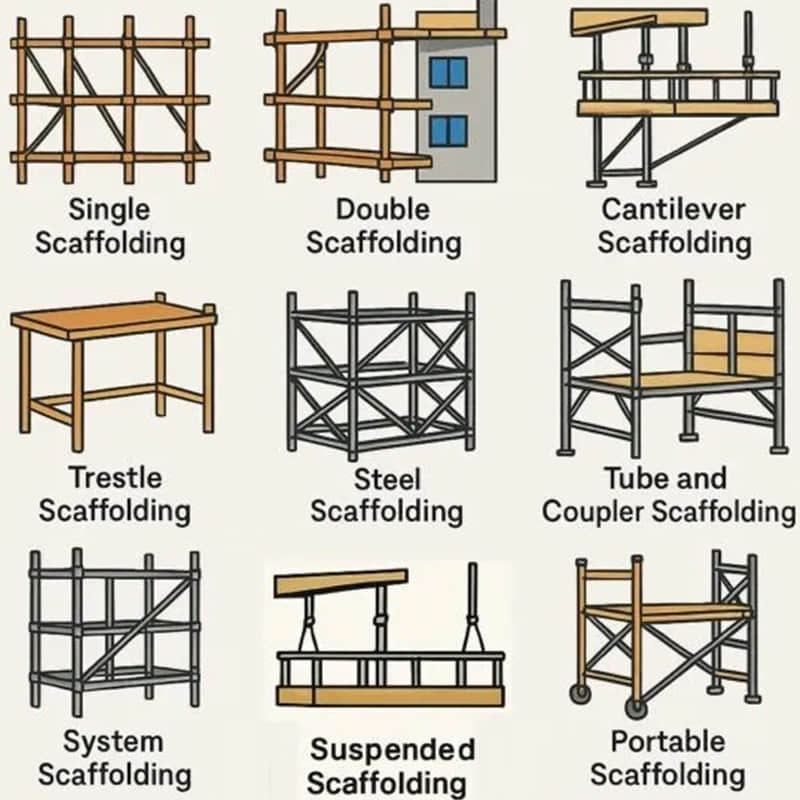
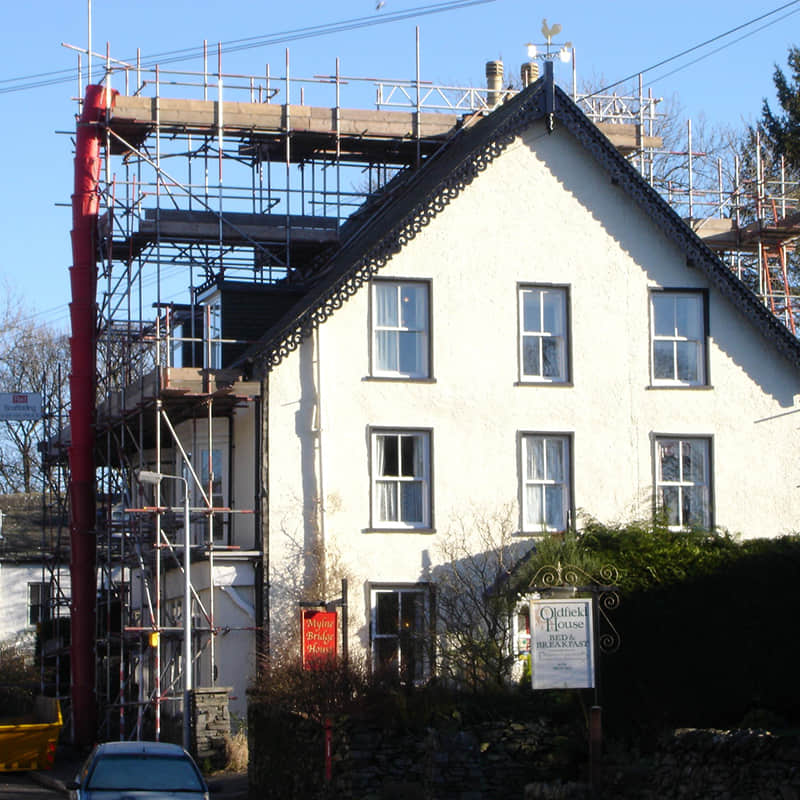
    Safety and efficiency when working from heights are critical aspects of the construction industry. Access can be achieved through a variety of methods, including aerial lifts, suspended platforms, etc., but the traditional way of working platform, known as a supported scaffold, has remained the most basic and globally used method of access for contractors across the world. If you're in the position of a construction manager, scaffold rental company, or procurement officer within an industry, learning how supported scaffolding functions, its advantages, and what it cannot do provides a foundation to plan your projects properly; With this guide we will provide you with all the information necessary to choose the correct equipment when you decide to purchase supported scaffolding for the next project that you work on.     What is Supported Scaffolding?   Supported scaffolding is the category of scaffolding that supports one or more platforms using rigid load-bearing members (poles, legs, frames, uprights, posts, outriggers, etc.) to support the platform and all materials, tools, and workers performing on top of that platform. In contrast to suspended scaffolding, which is hung from an overhead support post (as in window-washing scaffolds), supported scaffolding is placed on solid ground and provides all of the necessary weight-bearing support to safely transfer the combined weight of workers, tools,s and materials to the ground. In addition, it is the accepted industry standard for structural construction, heavy masonry projects, and many long-term maintenance projects in which the types of loads being placed on the scaffold will require high levels of stability and load-bearing.     Supported Scaffolding Types   Supported scaffolding is not a "one-size-fits-all" solution. It comes in various configurations designed to meet specific architectural challenges. 1. Fabricated Frame Scaffolding Often referred to simply as "frame scaffold," this is the most common type seen on residential and light commercial sites. It consists of pre-fabricated metal frames connected by cross braces. Best feature: Extremely fast to erect and dismantle. Ideal for: Linear walls, masonry work, and plastering.   2. System Scaffolding (Modular) System scaffolding, such as Ringlock, Cuplock, or Kwikstage, uses vertical posts and horizontal ledgers that connect at fixed node points. Best feature: immense flexibility and high load capacity. Ideal for: Industrial plants, complex geometries, bridges, and circular structures.   3. Tube and Clamp Scaffolding This traditional method uses steel tubes and couplers. There are no pre-set locking points, allowing for infinite adjustability. Best feature: Can be adapted to fit any shape, no matter how irregular. Ideal for: Refineries and areas with heavy obstruction (pipes/ductwork).   4. Mobile Scaffolding (Rolling Towers) These are freestanding supported scaffolds mounted on castors (wheels). Best feature: Portability. Ideal for: Maintenance tasks (painting, electrical) where the crew needs to move frequently across a flat floor.       What Are the Advantages of Supported Scaffolding?   The reason why engineers and site managers continue to utilize supported scaffolding instead of newer technologies is simple: Supported scaffolding provides an incredibly stable, safe platform with the most significant type of load-bearing capacity.   1. Outstanding Stability and Safety Supported scaffolding consists of a grounded system where everything is secure—that is, there is no sway, and everything is completely secured. This stability gives workers the necessary balance to perform tasks that require great precision and accuracy, such as bricklaying and welding, which is critical to producing quality work.   2. High Load-Bearing Capacity When it comes to aerial lifts, weight limits will be set (in most cases, only two workers and their tools can fit on them). Supported scaffolds—specifically those classified as heavy-duty system scaffolding—are built to withstand far more weight than aerial lifts. As such, they allow workers to store pallets of bricks, mortar, steel beams, and multiple crew members on a single scaffold system at the same time.   3. Ample Working Surface Supported scaffolding allows for easy movement throughout the working surfaces of a building. This type of scaffolding supports a continuous working platform along the length of a building, allowing workers to walk along the length of the building without having to stop to adjust equipment, greatly improving productivity.   4. Long-Term Value and Durability For rental companies, supported scaffolding, mainly supported by hot-dipped galvanized steel, has very high Return on Investment (ROI) values. Supported scaffolding is weather-resistant, remains usable for many years, and requires little maintenance.     What Are the Disadvantages of Supported Scaffolding?   To make an informed decision, one must also consider the limitations. 1. Foundation Requirements Supported scaffolding needs a stable foundation in order to be effective. A stable foundation consists of a level area with sufficient support to provide stability while it sits on top of the ground. So, where the surface is not even or if the soil is weak, scaffoldings are built using mudsills and base plates, which will help to minimize the risk of the supported scaffolding either sinking or tipping over.   2. Large Footprint When a supported scaffolding is being built from the ground up, the bottom of the scaffolding has physical space taken up. In dense, crowded cities where there is not enough room for scaffolding to be located on the sidewalk or in front of a building, special permits and pedestrian safety tunnels should be obtained.   3. Erection and Dismantling Time Unlike a boom lift, which can be operated and used immediately upon being delivered to its "job site, supported scaffolding requires that a qualified person construct it. Therefore, erecting supported scaffolding and disassembling it after the project has ended requires more skilled labor, which can increase the initial labor costs.     What Are the Uses of Supported Scaffolding?   The versatility of supported scaffolding makes it ubiquitous across several sectors. 1. General Construction & Civil Engineering From high-rise residential blocks to office complexes, supported scaffolding is used for structural work, façade installation, bricklaying, and window installation.   2. Industrial Maintenance In power plants, oil refineries, and chemical factories, system scaffolding is used to access boilers, smokestacks, and piping systems for routine maintenance and shutdowns.   3. Infrastructure Projects Bridge construction and repair rely heavily on supported scaffolding to create platforms for workers to operate under or alongside the bridge deck.   4. Shipbuilding and Marine Supported scaffolds are erected around ship hulls in dry docks, allowing teams to weld, paint, and repair massive vessels.   5. Temporary Public Structures Interestingly, the same components (especially Ringlock systems) are often used to build temporary grandstands, stages, and lighting towers for concerts and sporting events.       Conclusion   In the construction industry, supported scaffolding is used predominantly. Even though planning for supported scaffold foundations and assembly time is important, there are benefits of using supported scaffolding, including superior stability, capacity for high loads, and increased safety, which can make it the best choice for medium-to-large-sized projects. Supported scaffolding will help ensure crew safety when you are a contractor, or grow your rental inventory when you are a rental company; therefore, making the proper supported scaffold selection will be one of the most critical aspects of successfully operating your business.   Upgrade Your Scaffolding Solutions Today   Are you looking for reliable, certified, supported scaffolding for your next project? Or perhaps you need to restock your rental inventory with high-quality frames and modular systems? [Contact Our Team] today for expert advice and a competitive quote tailored to your specific needs.       FAQ   What is the maximum height for supported scaffolding?  Theoretically, supported scaffolding can be built to significant heights, provided the base is strong enough. However, standard safety regulations (like OSHA) dictate a strict height-to-base ratio (typically 4:1) to prevent tipping. If a scaffold exceeds this ratio, it must be restrained from tipping by using ties, guys, or braces to secure it to the building structure. For extremely tall structures (over 125 feet), a professional engineer is usually required to design the system.   How often must supported scaffolding be inspected?  According to safety standards, supported scaffolding must be inspected by a "Competent Person" before each work shift and after any occurrence that could affect a scaffold's structural integrity (such as a storm or impact). Regular inspections ensure that base plates are stable, connections are tight, and no components are damaged.   Can I mix scaffolding components from different manufacturers?  It is generally not recommended to mix components from different manufacturers, even if they look similar. Slight variations in tolerance, steel grade, or locking mechanisms can compromise the structural integrity. If mixing is necessary, it must be approved by a qualified engineer to ensure the mixed components fit together safely and maintain load capacity.

Need Help? Chat with us

Leave a Message
If you are interested in our products and want to know more details, please leave a message here, we will reply you as soon as we can.
Submit
Contact us #
+86 -13922304881

Our hours

Mon 11/21 - Wed 11/23: 9 AM - 8 PM
Thu 11/24: closed - Happy Thanksgiving!
Fri 11/25: 8 AM - 10 PM
Sat 11/26 - Sun 11/27: 10 AM - 9 PM
(all hours are Eastern Time)

Home

Products

whatsApp

contact