• Formwork Safety: Risks, Prevention, and Best Practices
    Formwork Safety: Risks, Prevention, and Best Practices Feb 19, 2025
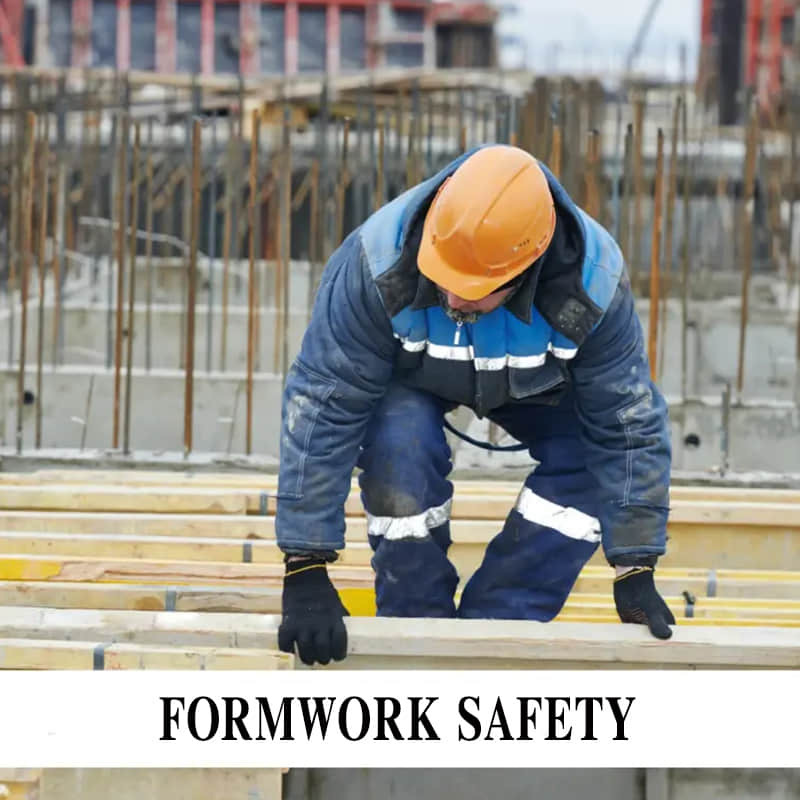
    Formwork is a critical component of construction; they serve the essential purpose of supporting concrete structures until they gain sufficient strength. Numerous hazards related to formwork have considerable implications regarding the level of risk constituted to workers and projects when not managed properly. In this blog post, we will discuss the various forms of hazards involved with formwork construction, reiterate the modalities that can be employed to mitigate the hazards, and zero in on the legalities involved. By following these methods, you could create a safer, better construction site.         Common Hazards in Formwork Construction     Structural Instability In the catastrophe of formwork failing or collapsing, considers one of the most dangerous incidences on the construction site. These could be:. Overloading: Some action or condition increases loads on a formwork system above its limit. Inadequate Bracing: Sudden failure occurs in the presence of weak or poorly installed braces. Poor Assembly: Misalignment, poorly secured fastenings, or poor installation may increase the potential for instability. Early Removal: Premature detaching before the concrete takes adequate strength can cause weakness or worse. All parts shall be fixed together properly and proper load distribution calculated before concrete is placed in order to avoid structural failure.     Falling Materials Loose panels, tools, or debris falling from elevating formwork can result in great hazards to the worker below. The reasons for this are: Unsecured parts-Such as panels, clamps, or connectors that are loosely fastened. Vibration-Objects will start shaking due to machine operations or concrete pouring. Lack of a barrier-protective devices are basically insufficient to prevent the falling materials from getting to the workers at the lower levels. The installation of safety nets, toe boards, and proper tying of materials will greatly reduce the risks posed by falling hazards.     Manual Material Handling Injuries When heavy concrete forms are handled without the proper type of equipment or the necessary techniques, there can be:   Muscle strains resulting from lifting heavy panels;   Injuries occurring to the lower back, usually from poor posture or additional effort;   Crush injuries suffered as a result of an assembly or adjustment being made to formwork while the load was on it. The use of mechanical lifting aids, proper training on lifting techniques, and ergonomic work practices can minimize manual handling risks.   Load Failures Formwork that cannot withstand fresh concrete pressure may buckle or collapse across. It occurs due to: Concrete pressure underestimated: Wet concrete applies vast lateral force; thus, a strong support is required. Material fatigue: Over time, reused formwork parts can lose strength. Environmental stresses: Wind and temperature modes can adversely affect material strength. Making proper calculations for the applied loads and application of good-quality materials are ways to avoid structural failures.         Best Practices for Formwork Safety     Training and Supervision Supervised training is a must for workers working with formwork systems. Special attention should be on the following: Installation procedures - correct methods of assembly. Hazard awareness - different conditions under which hazards apply. Emergency response - respect for procedures to be followed for any type of structural failure. Supervisors must ensure that workers follow safety procedures, along with experienced personnel overseeing critical formwork operations.   Regular Inspections Frequent inspections often help pinpoint weak spots that haven't become hazards yet. Inspection should cover: Structural integrity-checking for cracks, misalignments, or loose fastenings. Load-bearing capability-assuring placement of loading is within fragile limits. Environmental impact-monitoring conditions of weather and climate that will affect the formwork's stance. The inspections should occur before, during, and after concrete pouring.   Material Quality and Maintenance Durability and strength of the components of formwork have a direct linkage to safety. Best practices involve the following:   Use certified materials that meet industry standards. Inspect reuse components for degradation or damage. They should be stored right so that they would not warp or weaken due to moisture exposure. Higher grades of materials can minimize failure factors during concrete pouring.     Prop and Bracing Best support systems contribute to avoiding collapse. Important considerations to keep in mind are: Spacing and alignment – Ensuring even weight distribution. Secure fastenings – Using strong connectors to prevent movement. Adjustments during pouring – Monitoring shifting loads to prevent instability. Using adjustable supports allows for real-time load management and enhanced stability.       Worker Safety Measures     Protective Equipment PPE are meant to reduce injuries. The mandatory equipment includes: Hard hats-protect from falling debris. Safety gloves-used to prevent cuts and abrasions. Steel-toe boots-these are to protect the feet from the heavy loads. Fall arrest systems – Securing workers at heights. Use of proper PPE equipment shall always be emphasised on site.     Safe Work Procedures Strict safety protocols reduce on-site accidents. Key practices include: Following manufacturer guidelines for formwork assembly and removal. Avoiding overloading platforms and scaffolding. Keeping the site organized to minimize trip hazards. Regular safety briefings help reinforce these procedures.   Team Coordination Clear communication between workers and supervisors ensures smooth operations. Best practices: Pre-task meetings – Discussing safety concerns before work begins. Signaling systems – Using hand signals or radios for clear instructions. Emergency planning – Establishing procedures for responding to structural failures. Effective coordination enhances overall site safety.       Environmental Considerations   Weather-Related Risks Environmental conditions can compromise formwork stability. Factors to consider: Wind loads – Strong winds may cause displacement. Rain and humidity – Excess moisture weakens materials and makes surfaces slippery. Temperature changes – Extreme cold or heat affects concrete setting and material strength. Work schedules should be adjusted based on weather forecasts to minimize risks.   Sustainable Formwork Practices Eco-friendly alternatives improve efficiency and reduce waste. Strategies include: Reusable plastic formwork – Durable and cost-effective. Optimized material usage – Reducing excess waste. Recycling old formwork components – Minimizing environmental impact. Sustainable solutions contribute to safer and more efficient construction practices.       Regulatory Compliance   Safety Standards Organizations like OSHA establish guidelines for formwork safety. Key requirements include: Proper load calculations to prevent overloading. Secure bracing and shoring to support structural stability. Worker protection measures such as fall prevention systems. Following these regulations ensures compliance and prevents legal liabilities.   Local Construction Codes Each region has specific building regulations regarding formwork. Adherence to these codes ensures: Structural integrity for long-term stability. Legal compliance to avoid fines or work stoppages. Worker safety through standardized best practices. Understanding local requirements is crucial for project success.         Cost-Effective Safety Investments   Long-Term Benefits of Safety Prioritizing safety reduces financial risks by preventing: Accident-related expenses such as medical costs and legal fines. Project delays due to equipment failure or regulatory violations. Material wastage from formwork collapse or rework. Investing in high-quality safety measures results in cost savings over time.   Reducing Risk Through Planning Proactive risk management lowers the likelihood of accidents. Best practices include: Thorough project planning to identify potential hazards. Using certified materials to ensure durability. Continuous monitoring to detect early warning signs of failure. Strategic planning enhances both safety and operational efficiency.         Conclusion   Formwork safety is a critical aspect of concrete construction. By recognizing hazards, enforcing best practices, and complying with regulations, construction teams can create a safer work environment. Investing in quality materials, proper training, and well-planned procedures not only protects workers but also enhances project efficiency and cost-effectiveness. A strong commitment to safety ensures the long-term success of any construction project.       FAQS     What are the common causes of formwork collapses? Common causes include inadequate design, improper installation, overloading, and poor-quality materials.   What PPE is required for formwork activities? Essential PPE includes helmets, gloves, safety harnesses, and non-slip footwear.       Related Information   Code of Practice: Formwork----SafeWork Formwork----Wikipedia
  • Single vs Double Scaffolding: The Ultimate Guide for Construction Projects
    Single vs Double Scaffolding: The Ultimate Guide for Construction Projects Jun 11, 2026
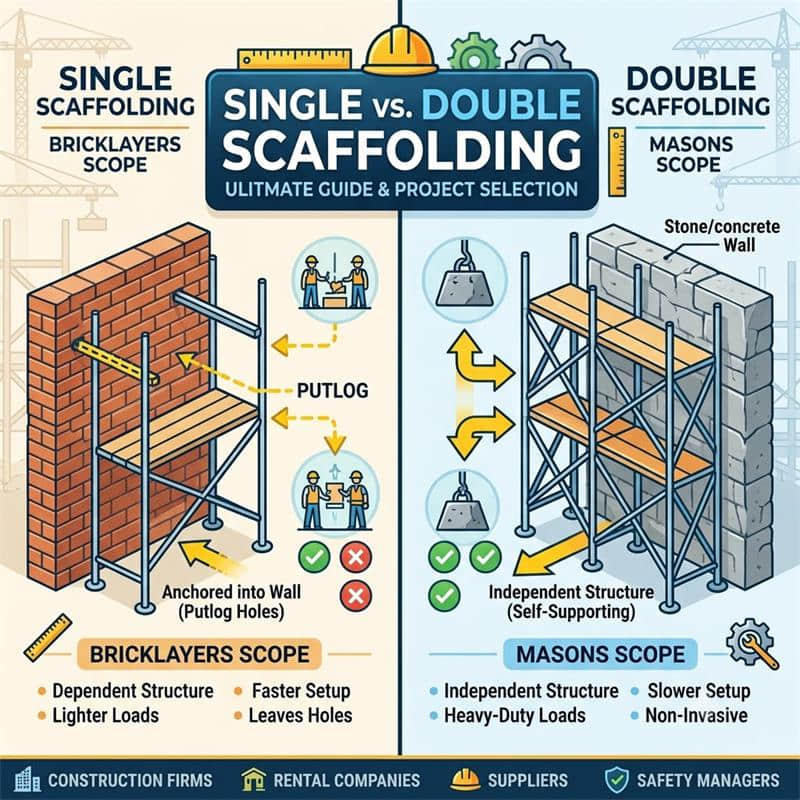
    When executing any construction, maintenance, or renovation project, safety and efficiency are paramount. At the heart of these priorities lies the selection of the right temporary support structure: scaffolding. While there are numerous types of scaffolding systems available today, two fundamental configurations remain industry staples—single scaffolding and double scaffolding. Choosing the wrong type can compromise worker safety, lead to project delays, or incur unnecessary rental and labor costs. In this comprehensive guide, we will break down the structural differences, ideal use cases, safety profiles, and cost implications of both systems to help you make an informed decision for your next project.       What is Single Scaffolding? (Bricklayers Scaffolding)   Single scaffolding is a traditional system primarily used for brick masonry work, which is why it is widely known as bricklayer's scaffolding. The defining characteristic of single scaffolding is its reliance on the building's existing wall for structural support. It consists of a single row of vertical standards (uprights) placed parallel to the wall, positioned roughly 1.2 to 1.5 meters away.   Key Components & Mechanics: Standards: Vertical poles anchored to the ground. Ledgers: Horizontal poles running parallel to the wall, tied to the standards at vertical intervals (usually 1.2 to 1.5 meters). Putlogs: Short horizontal members that rest transversely on the ledgers. Crucially, one end of the putlog enters a hole made directly into the building's wall, while the other end is supported by the ledger. Industry Note: Because it requires piercing the structure to hold the putlogs, single scaffolding is generally limited to new brickwork construction where holes can be easily left open and filled later.       What is Double Scaffolding? (Masons Scaffolding)   Unlike its single counterpart, double scaffolding is entirely independent of the building's walls for vertical load support. For this reason, it is frequently referred to as mason's scaffolding or independent scaffolding. Double scaffolding consists of two rows of vertical standards. The first row is placed close to the wall (around 20 to 30 cm away), and the second row is placed parallel to the first, roughly 1 meter to 1.2 meters further out.   Key Components & Mechanics: Two Rows of Standards: Working together, they eliminate the need to pierce the building's facade. Ledgers & Transoms: Ledgers connect the standards horizontally, while transoms (similar to putlogs) bridge the gap between the inner and outer rows of standards to support the working platform. Rakers and Bracing: Because it does not anchor into the wall for weight-bearing, it utilizes diagonal rakers and cross-bracing to ensure lateral stability.       Key Differences: Single vs. Double Scaffolding   To help you quickly evaluate which system aligns with your current inventory or project requirements, let's compare them across critical operational matrices:   Feature Single Scaffolding (Bricklayers) Double Scaffolding (Masons) Wall Dependency High (Requires putlog holes in the wall). None (Completely independent/freestanding). Row of Standards Single row. Double row (Inner and Outer). Load Capacity Light to Medium duty (Best for workers and light materials). Heavy-duty (Can support stone blocks, heavy tools, and multiple workers). Primary Material Compatibility Brick masonry. Stone masonry, structural glazing, concrete repair, and cladding. Installation Speed Faster setup and teardown, fewer components. Slower setup, requires more precision, and components. Surface Impact Leaves holes that require subsequent patching. Non-invasive; leaves the facade completely untouched.     When to Choose Single Scaffolding     Single scaffolding is highly efficient under the right conditions. It is the optimal choice when: You are constructing a new brick building: Leaving temporary gaps for putlogs is easily integrated into the bricklaying workflow. Budget and speed are tight: It requires fewer tubes, couplers, and boards, lowering transportation and labor installation costs. Space on the ground is limited: Having only one row of standards minimizes the footprint on crowded urban jobsites or narrow alleys.         When to Choose Double Scaffolding     Double scaffolding is the industry standard for complex engineering and heavy-duty structural work. You should opt for this system when: Working on stone masonry or concrete walls: It is incredibly difficult or forbidden to punch holes into stone facades or reinforced concrete. Executing restoration or maintenance: Historical buildings and structural repairs require non-destructive access, making independent scaffolding mandatory. Heavy material storage is required on platforms: If your crew needs hoisted stone blocks, heavy mortar mixers, or heavy-duty power tools on the deck, the dual-standard framework offers the necessary weight distribution.         Safety and Compliance Considerations     Regardless of the system you select, compliance with local safety regulations (such as OSHA or EN standards) is non-negotiable. For Single Scaffolding: The critical safety vulnerability lies in the wall connection. If the putlogs are not firmly seated or if the brickwork is unstable, the system can fail. Regular inspections are required to ensure the wall holes have not degraded. For Double Scaffolding: Stability hinges on correct diagonal bracing and ground conditions. Because it carries significantly higher loads, the sole boards (mud sills) must be properly bedded on stable, compacted ground to prevent sinking.         Conclusion   In the debate between single vs double scaffolding, there is no single winner—only the right tool for the specific application. Single scaffolding offers unparalleled cost-efficiency and speed for standard brickwork. Conversely, double scaffolding provides the robust stability, heavy load-bearing capacity, and non-invasive access required for stone masonry, structural glazing, and high-rise renovations. For scaffolding procurement managers, project engineers, and equipment distributors, optimizing your inventory with a balanced mix of both configurations ensures you can meet any structural challenge safely and cost-effectively.     Optimize Your Construction Fleet Today   Looking to upgrade your project safety or expand your scaffolding rental inventory? We supply premium-grade, certified scaffolding components—from heavy-duty standards to high-tensile couplers—tailored to meet the rigorous demands of modern construction. [Contact our engineering team today] for a customized quote or to discuss the ideal scaffolding configuration for your upcoming project.       FAQ   1. Why is double scaffolding called mason's scaffolding? Double scaffolding is known as mason's scaffolding because stone masonry work rarely allows for holes to be made in the wall to support scaffolding members (putlogs). Since stone blocks are heavy and walls are often finished, masons require a completely independent, heavy-duty structure that stands on its own two rows of standards without damaging the facade. 2. Can single scaffolding be used for high-rise construction? Generally, no. Single scaffolding is limited in height because it relies heavily on the structural integrity of the wall and a single row of standards. For high-rise projects, double scaffolding or specialized systems like suspended or modular scaffolding are required to ensure compliance with modern construction safety standards and load requirements. 3. What is the standard spacing for standards in double scaffolding? In standard double scaffolding configurations, the inner row of standards is placed approximately 20 to 30 cm from the wall, while the outer row is spaced 1 to 1.2 meters away from the inner row. The longitudinal spacing between each standard along the wall typically ranges from 2 to 2.5 meters, depending on the expected load capacity.
Leave a Message
If you are interested in our products and want to know more details, please leave a message here, we will reply you as soon as we can.
Submit

Need Help? Chat with us

Leave a Message
If you are interested in our products and want to know more details, please leave a message here, we will reply you as soon as we can.
Submit

Our hours

Mon 11/21 - Wed 11/23: 9 AM - 8 PM
Thu 11/24: closed - Happy Thanksgiving!
Fri 11/25: 8 AM - 10 PM
Sat 11/26 - Sun 11/27: 10 AM - 9 PM
(all hours are Eastern Time)

Home

Products

contact