• The Comprehensive Guide to Erecting Ringlock Scaffolding Jul 15, 2023
    Introduction       Welcome to our comprehensive guide on erecting ringlock scaffolding. In this article, we will provide you with a step-by-step process to help you successfully set up ringlock scaffolding for your construction projects. Ringlock scaffolding is a versatile and popular choice due to its durability, flexibility, and ease of assembly. By following our detailed instructions, you will be able to efficiently erect ringlock scaffolding while ensuring safety and stability.         Requirements For Ringlock Scaffolding Assembly Before we delve into the assembly process, let's discuss the essential components and tools you'll need for erecting ringlock scaffolding:   Components: Vertical Standards: These are the main vertical components that form the framework of the scaffold. Ledgers: Horizontal components that connect the vertical standards, providing structural stability. Diagonals: Diagonal braces that increase the rigidity of the scaffold structure. Base Jacks: Adjustable components are used to level the scaffolding on uneven surfaces. Steel Planks: Platforms where workers can stand and perform tasks. Toe Boards: Placed along the edges of the scaffold to prevent tools or materials from falling.     Tools: Hammer: For securing components in place. Wrench: Used for tightening nuts and bolts. Spirit Level: Ensures the scaffolding is level and plumb. Tape Measure: For precise measurements. Safety Equipment: Hard hat, safety harness, gloves, and non-slip footwear. Now that we have the necessary components and tools, let's move on to the step-by-step process of erecting ring-lock scaffolding.     Step 1: Foundation Preparation Clear the work area from any obstacles, debris, or potential hazards. Ensure the ground is level and stable. Place base plates or sole boards on the ground to provide a solid foundation. Adjust the base jacks on each standard to level the scaffolding.     Step 2: Vertical Standard Assembly Start by connecting the first vertical standard to the base jack. Insert the spigot of the next standard into the lower cup of the first standard. Rotate the standard until the spigot locks into place.       Step 3: Ledger and Diagonal Placement Attach ledgers horizontally between the vertical standards, ensuring a secure fit. Add diagonals diagonally between the ledgers to enhance stability. Repeat this process for each level of the scaffolding.     Step 4: Platform Installation Place steel planks across the ledgers, ensuring they are secured in position. Ensure the planks are level and overlap properly to prevent tripping hazards. Install toe-boards along the edges of the scaffolding platforms for added safety.     Step 5: Safety Measures 1. Prioritize safety by providing workers with appropriate personal protective equipment (PPE) such as hard hats, safety harnesses, gloves, and non-slip footwear. 2. Clearly mark the scaffolding area with warning signs to prevent unauthorized access. 3. Regularly inspect the scaffolding for any signs of damage or instability and address them immediately. 4. Train workers on proper scaffold usage, including safe climbing techniques and weight limitations.       Step 6: Final Checks 1. Before allowing workers onto the scaffolding, perform a thorough final check. 2. Ensure all components are securely in place, with no loose connections or missing parts. 3. Confirm that the scaffolding is level, plumb, and stable using a spirit level. 4. Double-check the integrity of the steel planks and toe boards for any signs of damage.       You can refer to our product construction video:     Conclusion       By following this comprehensive guide, you are now equipped with the knowledge to erect ringlock scaffolding for your construction projects effectively. Remember to prioritize safety throughout the assembly process and conduct regular inspections to maintain the stability and integrity of the scaffolding.       In addition to providing you with professional interlocking scaffolding tutorial files and videos, AJ Scaffolding also has professional technicians to provide you with professional guidance services. In addition to interlocking scaffolding, we also provide other building materials, such as scaffolding accessories, formwork and its accessories, etc., to provide you with a one-stop building materials procurement service. If you have any questions about the construction of interlocking scaffolding, or want to purchase other building materials, please contact us!   FAQ   What Is The Difference Between Ring Lock And Cuplock Scaffolding? Ring Lock scaffolding uses a wedge and disc system for connection, which is easy and quick to install and remove, and has high flexibility and stability. Cuplock scaffolding uses a cup buckle system for connection, which is quick to install and has good overall stability, suitable for large-scale and repeated use projects.   What Size Is Ringlock Scaffolding? Common sizes of Ringlock scaffolding include standard parts (0.5m to 3m), crossbars (0.5m to 3m) and diagonal braces (0.7m to 3m), which can be customized according to needs.   What Is The Safety Distance For Scaffolding? The safe distance of scaffolding is usually at least 3 meters away from power lines, and a working range of 1.5 meters is maintained around the building.       Relevant Information   What Is Ringlock Technology In Scaffolding? --- QUORA Experimental Studies Of Ringlock Scaffolding Joint --- RESEARCHGATE Scaffolding Families -Best Method To Use? --- FORUMS  
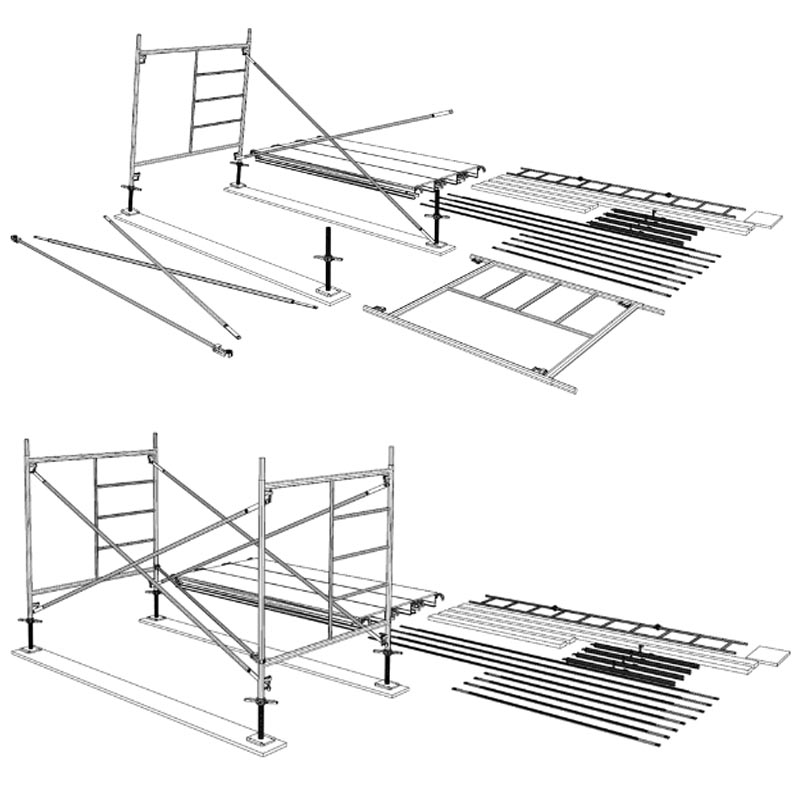
  • How To Set Up Frame Scaffolding: A Comprehensive Guide
    How To Set Up Frame Scaffolding: A Comprehensive Guide Oct 20, 2023
          Frame scaffolding, often called modular scaffolding, consists of pre-fabricated frames that are stacked and connected to form a sturdy working platform. Its design allows for quick assembly and disassembly, making it perfect for projects requiring flexibility. However, improper setup can lead to serious accidents, so following best practices is critical. In this guide, we’ll walk you through everything you need to know about setting up frame scaffolding—from preparation to final safety checks. By the end, you’ll be equipped to set up frame scaffolding confidently and safely.       Tools And Materials You'll Need:   Frame scaffold components (vertical frames, horizontal braces, cross braces, and platforms) ** Base plates or screw jacks ** Leveling tools (spirit levels) ** Planks or scaffold boards ** Coupling pins and clips ** Safety equipment (hard hats, safety harnesses, fall protection) ** Hammer and wrenches ** Toe boards and guardrails (for safety) ** Scaffold tags and warning signs (for compliance)     Step-By-Step Guide To Setting Up Frame Scaffolding Step 1: Assess the Work Area   Prior to commencing scaffold assembly, evaluate the work area to confirm its suitability for scaffold positioning. Check for any obstacles, uneven ground, or overhead obstructions. Clear the area of debris or obstacles that could interfere with the scaffold's stability.   Step 2: Prepare the Foundation   In case of uneven ground, utilize base plates or screw jacks to establish a stable and level scaffold foundation. Adjust the screw jacks or base plates until the scaffold is level both horizontally and vertically. Use leveling tools such as spirit levels to ensure accuracy.   Step 3: Assemble the Vertical Frames   Begin by assembling the vertical frames (also called uprights or standards). Place the frames on the base plates or screw jacks at the desired locations. Make sure the frames are plumb (perfectly vertical) and secure them in place.   Step 4: Install Cross Braces   Install cross braces between the vertical frames. Cross braces provide lateral stability to the scaffold. Typically, they should be installed diagonally from the bottom of one frame to the top of the adjacent frame. Secure them in place using coupling pins and clips.   Step 5: Add Horizontal Braces   Install horizontal braces between the vertical frames at the desired heights. These braces provide additional support and prevent the frames from spreading apart. Secure them using coupling pins and clips.   Step 6: Place Platforms   Place the scaffold platforms (also called walk boards) on the horizontal braces. Ensure they are secure and supported evenly. The platforms should overhang the frames slightly but not excessively. They should also have adequate space for workers and materials.   Step 7: Secure Guardrails and Toe Boards   For safety, install guardrails and toe boards on the platforms to prevent falls. Ensure that guardrails are properly secured and meet safety standards.   Step 8: Perform Safety Checks Before allowing workers to access the scaffold, conduct safety checks. Inspect all components for damage or defects. Ensure that all couplings and connections are secure. Confirm that the scaffold is level and stable.   Step 9: Tag and Sign the Scaffold Place scaffold tags and warning signs at accessible locations to indicate that the scaffold has been inspected, is safe for use, and its weight capacity.   Step 10: Train Workers Ensure that workers using the scaffold are trained in scaffold safety, including the safe use of fall protection equipment.   Step 11: Regular Inspections After setting up frame scaffolding, ongoing maintenance is key to keeping it safe. Daily Inspections: Check for loose or damaged parts before each use. Weather Checks: Inspect after storms or high winds, which can affect stability. Clean Platforms: Remove debris to prevent tripping hazards. Prompt Repairs: Replace damaged components with compatible parts before reusing.         By following these steps and adhering to safety guidelines and regulations, you can set up a frame scaffold safely and efficiently for your construction or maintenance project. Keep in mind that prioritizing safety is crucial when working with scaffolds.       Key Safety Tips For Frame Scaffolding Setup   Manufacturer Guidelines: The manufacturer must be followed regarding construction and maximum load capacity. Personal Protective Equipments: No assembly should be carried out without proper protective gear-a hard hat, gloves, and boots. Don’t Exceed the Load Limits: Scaffolding is not to be overloaded. Each platform has a specific weight capacity-a measure for both workers and materials. Don’t Overreach: Reaching outside the platform edges will tip an erection scaffold. Regular Inspection: Daily inspections of scaffolding should always be done. They should ascertain if it is safe enough to work on following the exigencies of turbulent weather-following rain storms and snowstorms-for-the integrity of the structure.      FAQ   What Are The 2 Main Types Of Framed Scaffold? There are two main types: door frame scaffolding and ladder frame scaffolding   Which Type Of Scaffold Is Prohibited? The use of shore or lean-to scaffolds is prohibited.   What Is The Maximum Gap On Scaffolding? Standards require that the spacing between scaffolding boards or between scaffolding boards and uprights should not exceed one inch.     Read More   Supported Scaffolds -Frame or Fabricated -- OSHA What Is A Frame Scaffold -- QUORA What Is Scaffolding -- FLYABILITY
Leave a Message
If you are interested in our products and want to know more details, please leave a message here, we will reply you as soon as we can.
Submit

Need Help? Chat with us

Leave a Message
If you are interested in our products and want to know more details, please leave a message here, we will reply you as soon as we can.
Submit
Contact us #
+86 -13922304881

Our hours

Mon 11/21 - Wed 11/23: 9 AM - 8 PM
Thu 11/24: closed - Happy Thanksgiving!
Fri 11/25: 8 AM - 10 PM
Sat 11/26 - Sun 11/27: 10 AM - 9 PM
(all hours are Eastern Time)

Home

Products

whatsApp

contact